> ## Documentation Index
> Fetch the complete documentation index at: https://docs.restate.dev/llms.txt
> Use this file to discover all available pages before exploring further.
# Invocations
> Invoke handlers in Restate services over HTTP, Kafka or with typed clients.
An invocation is a request to execute a handler that is part of a Restate service.
There are three ways to invoke a handler: over HTTP, using typed clients, or through Kafka topics.
## HTTP invocations
To call a function over HTTP, send a request to the Restate Server, specifying the service and the function you want to invoke.
For example, to call the `processPayment` function of the `PaymentService`:
```bash theme={null}
curl -X POST localhost:8080/restate/call/PaymentService/processPayment \
--json '{"amount": 100, "currency": "USD"}'
```
The Restate Server ingress endpoint is here hosted at `localhost:8080`.
To call Virtual Objects or Workflows, you need to specify the object key or workflow ID in the URL.
For example, to call `updateBalance` of the `UserAccount` object with key `user123`:
```bash theme={null}
curl -X POST localhost:8080/restate/call/UserAccount/user123/updateBalance \
--json '{"amount": 50}'
```
Check out the [HTTP invocation](/services/invocation/http) docs to learn more.
## Typed client invocations
Use typed clients from external applications to invoke Restate handlers:
```typescript TypeScript {"CODE_LOAD::ts/src/foundations/invocations/client.ts#here"} theme={null}
//import * as clients from "@restatedev/restate-sdk-clients";
const restateClient = clients.connect({ url: "http://localhost:8080" });
// To call a service:
const greet = await restateClient
.serviceClient(greeterService)
.greet({ greeting: "Hi" });
```
```java Java {"CODE_LOAD::java/src/main/java/foundations/invocations/Client.java#here"} theme={null}
var restate = Client.connect("http://localhost:8080");
// To call a service:
MyServiceClient.fromClient(restate).myHandler(req);
```
```go Go {"CODE_LOAD::go/foundations/invocations/client.go#here"} theme={null}
restateClient := restateingress.NewClient("http://localhost:8080")
// To call a service
response, err := restateingress.Service[*MyInput, *MyOutput](
restateClient, "MyService", "MyHandler").
Request(context.Background(), &input)
if err != nil {
return err
}
```
For service-to-service calls within handlers, see [Service Communication](/foundations/actions#service-communication).
## Kafka invocations
You can connect your Restate handlers to Kafka topics, to let Restate invoke them for each message.
Consult the [Kafka Quickstart](/guides/kafka-quickstart) to get started.
## Idempotency
Add an idempotency key to your request header to let Restate deduplicate retries:
```bash theme={null}
curl -X POST localhost:8080/restate/call/PaymentService/processPayment \
-H 'idempotency-key: payment-123' \
--json '{"amount": 100, "currency": "USD"}'
```
On retry, Restate returns the first invocation’s result or lets you attach to it if still running.
## Flow control
Send an invocation through a *scope* to apply concurrency limits, capping how many invocations run at once for that scope. This helps you control cost, protect downstream services, and keep scheduling fair.
```bash theme={null}
curl -X POST localhost:8080/restate/scope/checkout/call/OrderService/checkout \
--json '{"orderId": "order-123"}'
```
See [flow control](/services/flow-control) to learn how to configure concurrency limits.
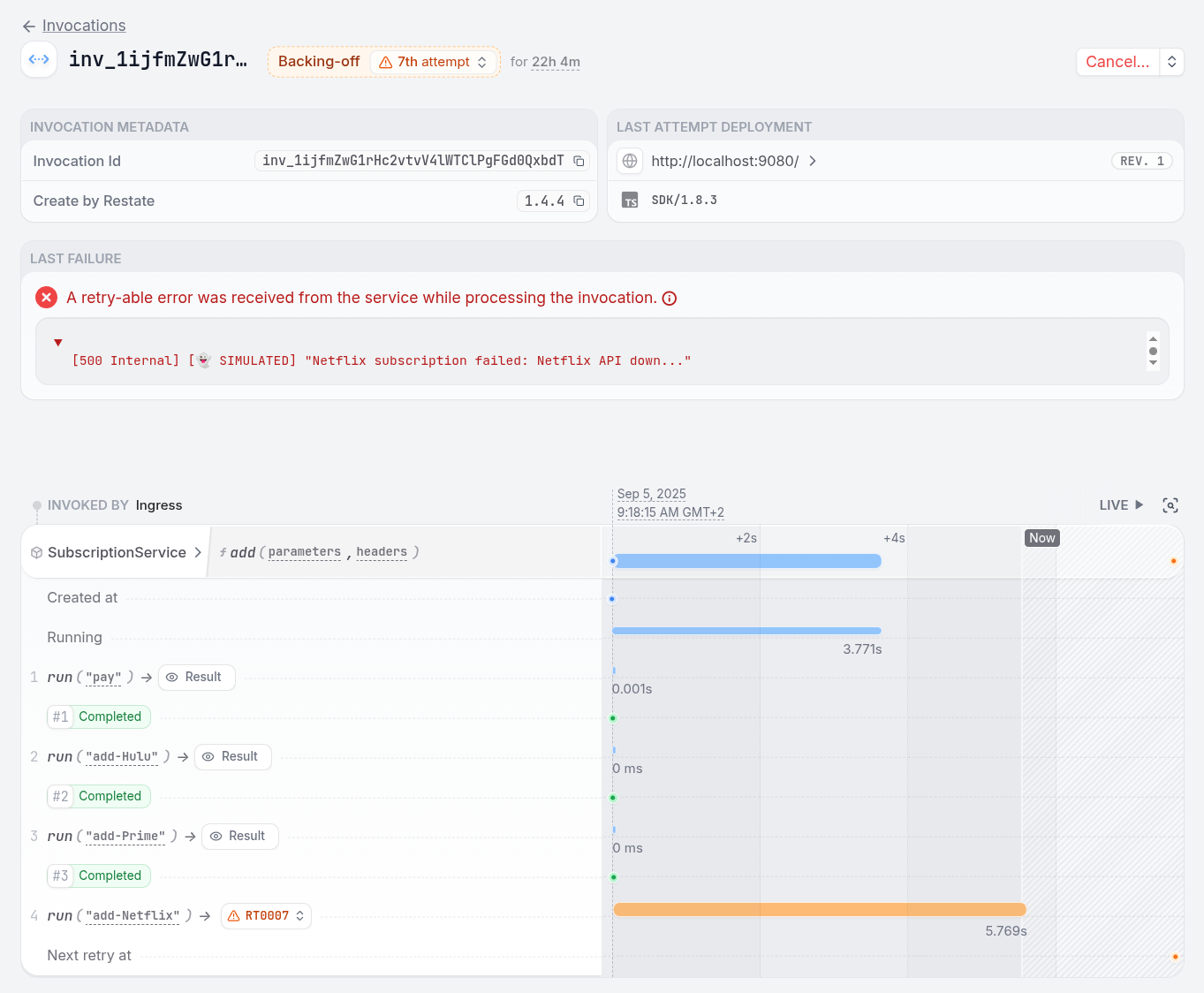
## Inspecting invocations
Use the Restate UI to monitor and troubleshoot invocations:
 ## Attaching to invocations
Attach to ongoing invocations to retrieve their results:
```typescript TypeScript {"CODE_LOAD::ts/src/foundations/invocations/client.ts#attach"} theme={null}
const handle = ctx
.serviceSendClient(myService)
.myHandler("Hi", sendOpts({ idempotencyKey: "my-key" }));
const invocationId = await handle.invocationId;
// Later...
const response = ctx.attach(invocationId);
```
```java Java {"CODE_LOAD::java/src/main/java/foundations/invocations/Client.java#attach"} theme={null}
var handle =
MyServiceClient.fromContext(ctx)
.send()
.myHandler("Hi", opt -> opt.idempotencyKey("my-key"));
var response = handle.attach().await();
```
```python Python {"CODE_LOAD::python/src/foundations/invocations/client.py#attach"} theme={null}
handle = ctx.service_send(my_handler, "Hi", idempotency_key="my-key")
invocation_id = await handle.invocation_id()
# Later...
await ctx.attach_invocation(invocation_id)
```
```go Go {"CODE_LOAD::go/foundations/invocations/client.go#attach"} theme={null}
// Execute the request and retrieve the invocation id
invocationId := restate.
ServiceSend(ctx, "MyService", "MyHandler").
Send("Hi", restate.WithIdempotencyKey("my-idempotency-key")).
GetInvocationId()
// Later re-attach to the request
response, err := restate.AttachInvocation[string](ctx, invocationId).Response()
```
Or over HTTP:
```bash theme={null}
curl localhost:8080/restate/attach/inv_1234567890abcdef
```
This is useful when another process needs the result of an ongoing operation or wants to check whether it has completed.
## Cancelling invocations
Cancel running invocations when they're no longer needed:
```bash CLI theme={null}
restate invocations cancel inv_1234567890abcdef
```
```bash HTTP theme={null}
curl -X PATCH http://localhost:9070/invocations/inv_1gdJBtdVEcM942bjcDmb1c1khoaJe11Hbz/cancel
```
Or programmatically:
```typescript TypeScript {"CODE_LOAD::ts/src/foundations/invocations/client.ts#cancel"} theme={null}
const handle = ctx.serviceSendClient(myService).myHandler("Hi");
const invocationId = await handle.invocationId;
// Cancel the invocation
ctx.cancel(invocationId);
```
```java Java {"CODE_LOAD::java/src/main/java/foundations/invocations/Client.java#cancel"} theme={null}
var handle = MyServiceClient.fromContext(ctx).send().myHandler("Hi");
// Cancel the invocation
handle.cancel();
```
```python Python {"CODE_LOAD::python/src/foundations/invocations/client.py#cancel"} theme={null}
handle = ctx.service_send(my_handler, "Hi", idempotency_key="my-key")
invocation_id = await handle.invocation_id()
# Cancel the invocation
ctx.cancel_invocation(invocation_id)
```
```go Go {"CODE_LOAD::go/foundations/invocations/client.go#cancel"} theme={null}
// Execute the request and retrieve the invocation id
invocationId := restate.
ServiceSend(ctx, "MyService", "MyHandler").
Send("Hi").
GetInvocationId()
// I don't need this invocation anymore, let me just cancel it
restate.CancelInvocation(ctx, invocationId)
```
To roll back the actions the handler already completed before cancellation, check out at the [sagas guide](/guides/sagas).
## Attaching to invocations
Attach to ongoing invocations to retrieve their results:
```typescript TypeScript {"CODE_LOAD::ts/src/foundations/invocations/client.ts#attach"} theme={null}
const handle = ctx
.serviceSendClient(myService)
.myHandler("Hi", sendOpts({ idempotencyKey: "my-key" }));
const invocationId = await handle.invocationId;
// Later...
const response = ctx.attach(invocationId);
```
```java Java {"CODE_LOAD::java/src/main/java/foundations/invocations/Client.java#attach"} theme={null}
var handle =
MyServiceClient.fromContext(ctx)
.send()
.myHandler("Hi", opt -> opt.idempotencyKey("my-key"));
var response = handle.attach().await();
```
```python Python {"CODE_LOAD::python/src/foundations/invocations/client.py#attach"} theme={null}
handle = ctx.service_send(my_handler, "Hi", idempotency_key="my-key")
invocation_id = await handle.invocation_id()
# Later...
await ctx.attach_invocation(invocation_id)
```
```go Go {"CODE_LOAD::go/foundations/invocations/client.go#attach"} theme={null}
// Execute the request and retrieve the invocation id
invocationId := restate.
ServiceSend(ctx, "MyService", "MyHandler").
Send("Hi", restate.WithIdempotencyKey("my-idempotency-key")).
GetInvocationId()
// Later re-attach to the request
response, err := restate.AttachInvocation[string](ctx, invocationId).Response()
```
Or over HTTP:
```bash theme={null}
curl localhost:8080/restate/attach/inv_1234567890abcdef
```
This is useful when another process needs the result of an ongoing operation or wants to check whether it has completed.
## Cancelling invocations
Cancel running invocations when they're no longer needed:
```bash CLI theme={null}
restate invocations cancel inv_1234567890abcdef
```
```bash HTTP theme={null}
curl -X PATCH http://localhost:9070/invocations/inv_1gdJBtdVEcM942bjcDmb1c1khoaJe11Hbz/cancel
```
Or programmatically:
```typescript TypeScript {"CODE_LOAD::ts/src/foundations/invocations/client.ts#cancel"} theme={null}
const handle = ctx.serviceSendClient(myService).myHandler("Hi");
const invocationId = await handle.invocationId;
// Cancel the invocation
ctx.cancel(invocationId);
```
```java Java {"CODE_LOAD::java/src/main/java/foundations/invocations/Client.java#cancel"} theme={null}
var handle = MyServiceClient.fromContext(ctx).send().myHandler("Hi");
// Cancel the invocation
handle.cancel();
```
```python Python {"CODE_LOAD::python/src/foundations/invocations/client.py#cancel"} theme={null}
handle = ctx.service_send(my_handler, "Hi", idempotency_key="my-key")
invocation_id = await handle.invocation_id()
# Cancel the invocation
ctx.cancel_invocation(invocation_id)
```
```go Go {"CODE_LOAD::go/foundations/invocations/client.go#cancel"} theme={null}
// Execute the request and retrieve the invocation id
invocationId := restate.
ServiceSend(ctx, "MyService", "MyHandler").
Send("Hi").
GetInvocationId()
// I don't need this invocation anymore, let me just cancel it
restate.CancelInvocation(ctx, invocationId)
```
To roll back the actions the handler already completed before cancellation, check out at the [sagas guide](/guides/sagas).