> ## Documentation Index
> Fetch the complete documentation index at: https://docs.restate.dev/llms.txt
> Use this file to discover all available pages before exploring further.
# Services
> Understanding Restate's three service types and when to use each
Restate provides three service types optimized for different use cases.
## Service types comparison
| | **Basic Service** | **Virtual Object** | **Workflow** |
| ---------------- | -------------------------------------------- | -------------------------------------------------------------------------------- | ---------------------------------------------------------- |
| **What** | Independent stateless handlers | Stateful entity with a unique key | Multi-step processes that execute exactly-once per ID |
| **State** | None | Isolated per object key | Isolated per workflow instance |
| **Concurrency** | Unlimited parallel execution | Single writer per key (+ concurrent readers) | Single `run` handler per ID (+ concurrent signals/queries) |
| **Key Features** | Durable execution, service calls | Built-in K/V state, single-writer consistency | Durable promises, signals, lifecycle management |
| **Best For** | ETL, sagas, parallelization, background jobs | User accounts, shopping carts, agents, state machines, stateful event processing | Approvals, onboarding workflows, multi-step flows |
## Basic Service
Basic Services group related handlers as callable endpoints.
```typescript TypeScript {"CODE_LOAD::ts/src/foundations/services/basic_service.ts#here"} theme={null}
const subscriptionService = restate.service({
name: "SubscriptionService",
handlers: {
add: async (ctx: restate.Context, req: SubscriptionRequest) => {
const paymentId = ctx.rand.uuidv4();
const payRef = await ctx.run(() =>
createRecurringPayment(req.creditCard, paymentId)
);
for (const subscription of req.subscriptions) {
await ctx.run(() =>
createSubscription(req.userId, subscription, payRef)
);
}
},
},
});
```
```java Java {"CODE_LOAD::java/src/main/java/foundations/services/SubscriptionService.java#here"} theme={null}
@Service
public class SubscriptionService {
@Handler
public void add(Context ctx, SubscriptionRequest req) {
var paymentId = ctx.random().nextUUID().toString();
String payRef =
ctx.run("pay", String.class, () -> createRecurringPayment(req.creditCard(), paymentId));
for (String subscription : req.subscriptions()) {
ctx.run("add-" + subscription, () -> createSubscription(req.userId(), subscription, payRef));
}
}
}
```
```python Python {"CODE_LOAD::python/src/foundations/services/basic_service.py#here"} theme={null}
subscription_service = restate.Service("SubscriptionService")
@subscription_service.handler()
async def add(ctx: Context, req: SubscriptionRequest) -> None:
payment_id = str(uuid.uuid4())
pay_ref = await ctx.run_typed(
"pay",
create_recurring_payment,
credit_card=req.credit_card,
payment_id=payment_id,
)
for subscription in req.subscriptions:
await ctx.run_typed(
"add-" + subscription,
create_subscription,
user_id=req.user_id,
subscription=subscription,
pay_ref=pay_ref,
)
```
```go Go {"CODE_LOAD::go/foundations/services/basic_service.go#here"} theme={null}
type SubscriptionService struct{}
func (SubscriptionService) Add(ctx restate.Context, req SubscriptionRequest) error {
paymentId := restate.UUID(ctx).String()
payRef, err := restate.Run(ctx, func(ctx restate.RunContext) (string, error) {
return createRecurringPayment(req.CreditCard, paymentId)
})
if err != nil {
return err
}
for _, subscription := range req.Subscriptions {
_, err := restate.Run(ctx, func(ctx restate.RunContext) (string, error) {
return createSubscription(req.UserId, subscription, payRef)
})
if err != nil {
return err
}
}
return nil
}
```
**Characteristics:**
* Use Durable Execution to run requests to completion
* Scale horizontally with high concurrency
* No shared state between requests
**Use for:** API calls, sagas, background jobs, task parallelization, ETL operations.
## Virtual Object
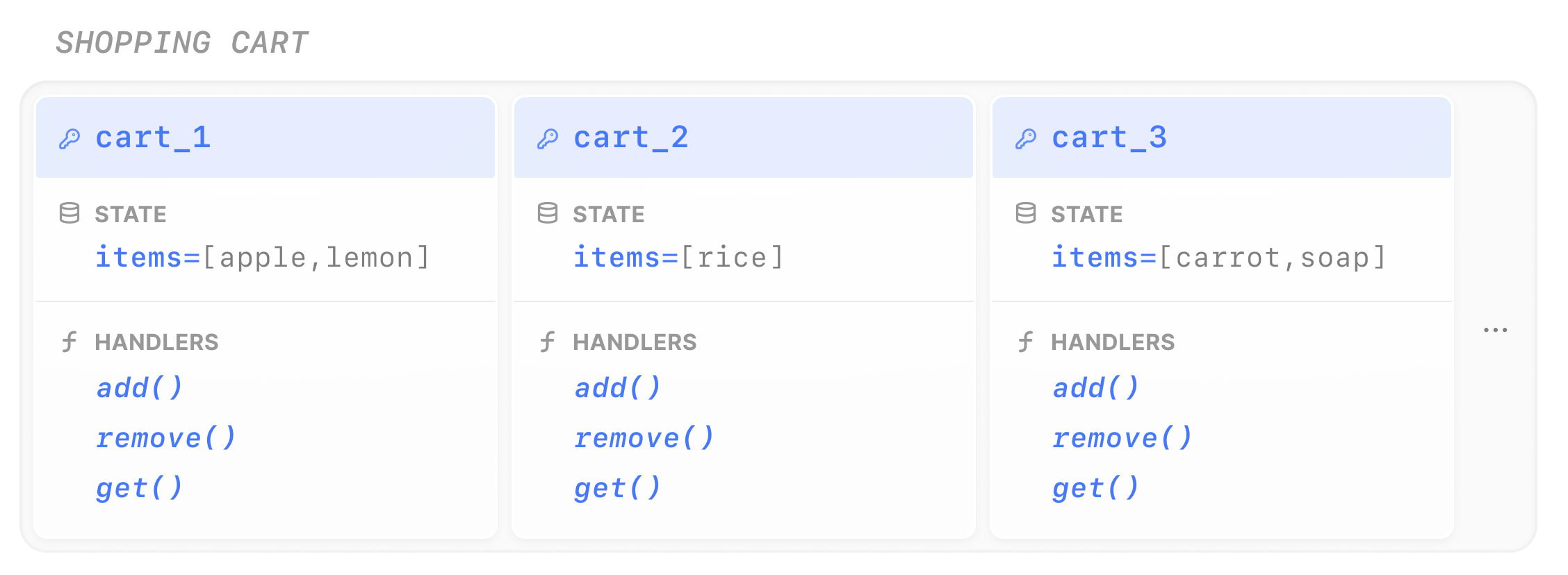
Stateful entities identified by a unique key.
 ```typescript TypeScript {"CODE_LOAD::ts/src/foundations/services/object.ts#here"} theme={null}
const cartObject = restate.object({
name: "ShoppingCart",
handlers: {
addItem: async (ctx: restate.ObjectContext, item: Item) => {
const items = (await ctx.get("cart")) ?? [];
items.push(item);
ctx.set("cart", items);
return items;
},
getTotal: restate.handlers.object.shared(
async (ctx: restate.ObjectSharedContext) => {
const items = (await ctx.get("cart")) ?? [];
return items.reduce((sum, item) => sum + item.price * item.quantity, 0);
}
),
},
});
```
```java Java {"CODE_LOAD::java/src/main/java/foundations/services/ShoppingCartObject.java#here"} theme={null}
@VirtualObject
public class ShoppingCartObject {
private static final StateKey CART = StateKey.of("cart", Cart.class);
@Handler
public Cart addItem(ObjectContext ctx, Item item) {
var cart = ctx.get(CART).orElse(new Cart());
var newCart = cart.addItem(item);
ctx.set(CART, newCart);
return cart;
}
@Shared
public double getTotal(SharedObjectContext ctx) {
var cart = ctx.get(CART).orElse(new Cart());
return cart.getTotalPrice();
}
}
```
```python Python {"CODE_LOAD::python/src/foundations/services/object.py#here"} theme={null}
cart_object = restate.VirtualObject("ShoppingCart")
@cart_object.handler()
async def add_item(ctx: ObjectContext, item: Item) -> Cart:
cart = await ctx.get("cart", type_hint=Cart) or Cart()
cart.items.append(item)
ctx.set("cart", cart)
return cart
@cart_object.handler(kind="shared")
async def get_total(ctx: ObjectSharedContext) -> float:
cart = await ctx.get("cart", type_hint=Cart) or Cart()
return sum(item.price * item.quantity for item in cart.items)
```
```go Go {"CODE_LOAD::go/foundations/services/object.go#here"} theme={null}
type ShoppingCartObject struct{}
func (ShoppingCartObject) AddItem(ctx restate.ObjectContext, item Item) ([]Item, error) {
items, err := restate.Get[[]Item](ctx, "items")
if err != nil {
return nil, err
}
items = append(items, item)
restate.Set(ctx, "items", items)
return items, nil
}
func (ShoppingCartObject) GetTotal(ctx restate.ObjectSharedContext) (float64, error) {
items, err := restate.Get[[]Item](ctx, "items")
if err != nil {
return 0, err
}
total := 0.0
for _, item := range items {
total += item.Price * float64(item.Quantity)
}
return total, nil
}
```
**Characteristics:**
* Use Durable Execution to run requests to completion
* K/V state retained indefinitely and shared across requests
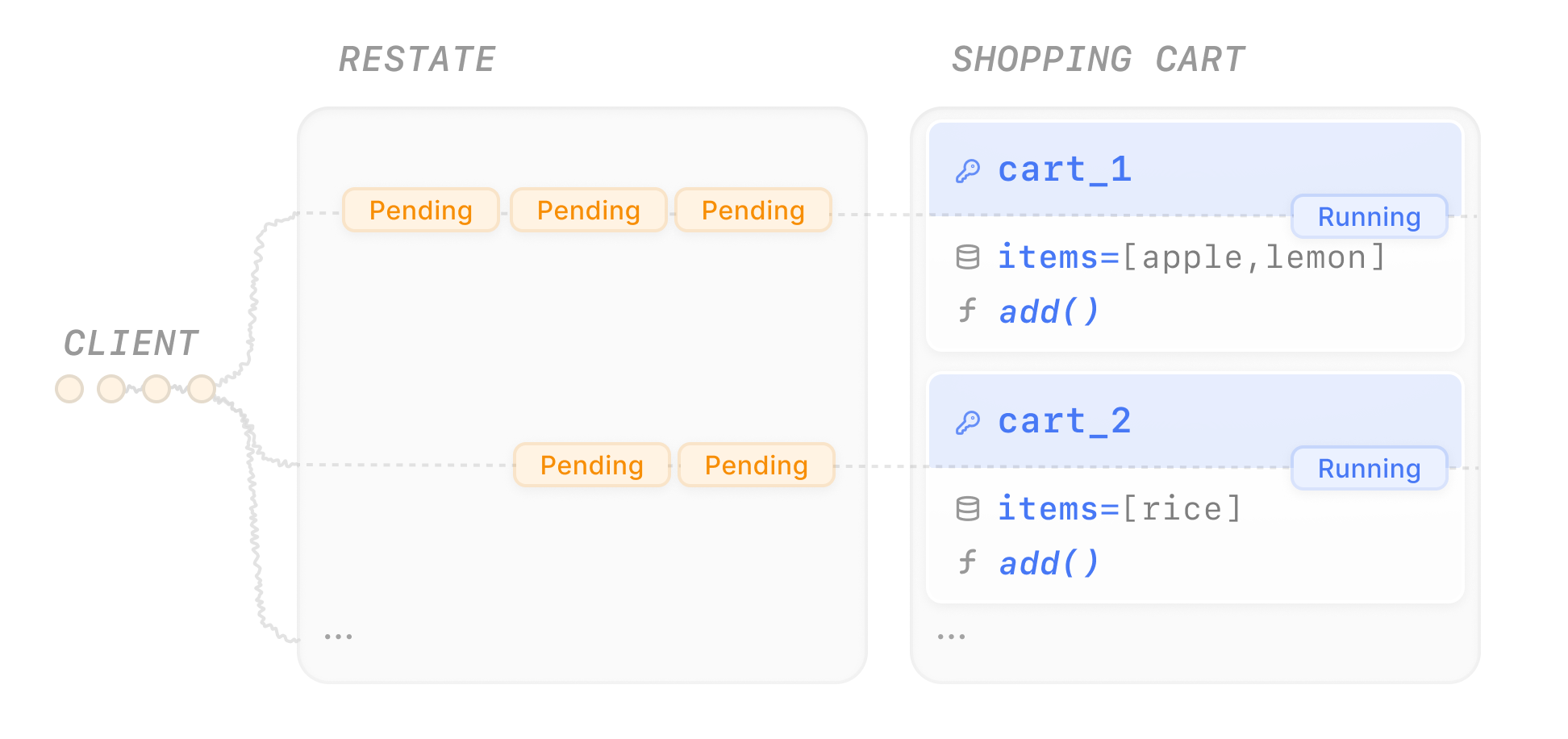
* Horizontal scaling with state consistency:
* At most one handler with write access can run at a time per object key. Mimicks a queue per object key.
* Concurrent execution across different object keys
* Concurrent execution of shared handlers (read-only)
```typescript TypeScript {"CODE_LOAD::ts/src/foundations/services/object.ts#here"} theme={null}
const cartObject = restate.object({
name: "ShoppingCart",
handlers: {
addItem: async (ctx: restate.ObjectContext, item: Item) => {
const items = (await ctx.get("cart")) ?? [];
items.push(item);
ctx.set("cart", items);
return items;
},
getTotal: restate.handlers.object.shared(
async (ctx: restate.ObjectSharedContext) => {
const items = (await ctx.get("cart")) ?? [];
return items.reduce((sum, item) => sum + item.price * item.quantity, 0);
}
),
},
});
```
```java Java {"CODE_LOAD::java/src/main/java/foundations/services/ShoppingCartObject.java#here"} theme={null}
@VirtualObject
public class ShoppingCartObject {
private static final StateKey CART = StateKey.of("cart", Cart.class);
@Handler
public Cart addItem(ObjectContext ctx, Item item) {
var cart = ctx.get(CART).orElse(new Cart());
var newCart = cart.addItem(item);
ctx.set(CART, newCart);
return cart;
}
@Shared
public double getTotal(SharedObjectContext ctx) {
var cart = ctx.get(CART).orElse(new Cart());
return cart.getTotalPrice();
}
}
```
```python Python {"CODE_LOAD::python/src/foundations/services/object.py#here"} theme={null}
cart_object = restate.VirtualObject("ShoppingCart")
@cart_object.handler()
async def add_item(ctx: ObjectContext, item: Item) -> Cart:
cart = await ctx.get("cart", type_hint=Cart) or Cart()
cart.items.append(item)
ctx.set("cart", cart)
return cart
@cart_object.handler(kind="shared")
async def get_total(ctx: ObjectSharedContext) -> float:
cart = await ctx.get("cart", type_hint=Cart) or Cart()
return sum(item.price * item.quantity for item in cart.items)
```
```go Go {"CODE_LOAD::go/foundations/services/object.go#here"} theme={null}
type ShoppingCartObject struct{}
func (ShoppingCartObject) AddItem(ctx restate.ObjectContext, item Item) ([]Item, error) {
items, err := restate.Get[[]Item](ctx, "items")
if err != nil {
return nil, err
}
items = append(items, item)
restate.Set(ctx, "items", items)
return items, nil
}
func (ShoppingCartObject) GetTotal(ctx restate.ObjectSharedContext) (float64, error) {
items, err := restate.Get[[]Item](ctx, "items")
if err != nil {
return 0, err
}
total := 0.0
for _, item := range items {
total += item.Price * float64(item.Quantity)
}
return total, nil
}
```
**Characteristics:**
* Use Durable Execution to run requests to completion
* K/V state retained indefinitely and shared across requests
* Horizontal scaling with state consistency:
* At most one handler with write access can run at a time per object key. Mimicks a queue per object key.
* Concurrent execution across different object keys
* Concurrent execution of shared handlers (read-only)
 **Use for:** Modeling entities like user accounts, shopping carts, chat sessions, AI agents, state machines, or any business entity needing persistent state.
## Workflow
Workflows orchestrate multi-step processes with guaranteed once-per-ID execution.
```typescript TypeScript {"CODE_LOAD::ts/src/foundations/services/workflow.ts#here"} theme={null}
const signupWorkflow = restate.workflow({
name: "UserSignup",
handlers: {
run: async (
ctx: restate.WorkflowContext,
user: { name: string; email: string }
) => {
// workflow ID = user ID; workflow runs once per user
const userId = ctx.key;
await ctx.run("create", () => createUserEntry({ userId, user }));
const secret = ctx.rand.uuidv4();
await ctx.run("mail", () => sendVerificationEmail({ user, secret }));
const clickSecret = await ctx.promise("email-link-clicked");
return clickSecret === secret;
},
click: async (
ctx: restate.WorkflowSharedContext,
request: { secret: string }
) => {
await ctx.promise("email-link-clicked").resolve(request.secret);
},
},
});
```
```java Java {"CODE_LOAD::java/src/main/java/foundations/services/SignupWorkflow.java#here"} theme={null}
@Workflow
public class SignupWorkflow {
private static final DurablePromiseKey EMAIL_LINK_CLICKED =
DurablePromiseKey.of("email-link-clicked", String.class);
@Workflow
public boolean run(WorkflowContext ctx, User user) {
// workflow ID = user ID; workflow runs once per user
String userId = ctx.key();
ctx.run(() -> createUserEntry(userId, user));
String secret = ctx.random().nextUUID().toString();
ctx.run(() -> sendVerificationEmail(user, secret));
String clickSecret = ctx.promise(EMAIL_LINK_CLICKED).future().await();
return clickSecret.equals(secret);
}
@Shared
public void click(SharedWorkflowContext ctx, ClickRequest request) {
ctx.promiseHandle(EMAIL_LINK_CLICKED).resolve(request.secret());
}
}
```
```python Python {"CODE_LOAD::python/src/foundations/services/workflow.py#here"} theme={null}
signup_workflow = restate.Workflow("UserSignup")
@signup_workflow.main()
async def run(ctx: WorkflowContext, user: User) -> bool:
# workflow ID = user ID; workflow runs once per user
user_id = ctx.key()
await ctx.run_typed("create", create_user_entry, user_id=user_id, user=user)
secret = str(ctx.uuid())
await ctx.run_typed("mail", send_verification_email, user=user, secret=secret)
click_secret = await ctx.promise("email-link-clicked", type_hint=str).value()
return click_secret == secret
@signup_workflow.handler()
async def click(ctx: WorkflowSharedContext, secret: str) -> None:
await ctx.promise("email-link-clicked", type_hint=str).resolve(secret)
```
```go Go {"CODE_LOAD::go/foundations/services/workflow.go#here"} theme={null}
type SignupWorkflow struct{}
func (SignupWorkflow) Run(ctx restate.WorkflowContext, user User) (bool, error) {
// workflow ID = user ID; workflow runs once per user
userId := restate.Key(ctx)
_, err := restate.Run(ctx, func(ctx restate.RunContext) (restate.Void, error) {
return createUserEntry(userId, user)
})
if err != nil {
return false, err
}
secret := restate.UUID(ctx).String()
_, err = restate.Run(ctx, func(ctx restate.RunContext) (restate.Void, error) {
return sendVerificationEmail(user, secret)
})
if err != nil {
return false, err
}
clickSecret, err := restate.Promise[string](ctx, "email-link-clicked").Result()
if err != nil {
return false, err
}
return clickSecret == secret, nil
}
func (SignupWorkflow) Click(ctx restate.WorkflowSharedContext, secret string) error {
return restate.Promise[string](ctx, "email-link-clicked").Resolve(secret)
}
```
**Characteristics:**
* Use Durable Execution to run requests to completion
* The `run` handler executes exactly once per workflow ID
* Other handlers run concurrently with the `run` handler to signal, query state, or wait for events
* Optimized APIs for workflow interaction and lifecycle management
**Use for:** Processes requiring interaction capabilities like approval flows, user onboarding, multi-step transactions, and complex orchestration.
## Choosing the right service type
**Start with Basic Services** for most business logic, data processing, and API integrations.
**Use Virtual Objects** to model stateful entities.
**Use Workflows** for multi-step processes that execute exactly-once and require interaction.
You can combine these service types within the same application for different aspects of your business logic.
## Deployments, Endpoints, and Versions
Services deploy behind endpoints. Multiple services can bind to the same endpoint.
```typescript TypeScript {"CODE_LOAD::ts/src/foundations/services/app.ts#here"} theme={null}
restate.serve({
services: [subscriptionService, cartObject, signupWorkflow],
port: 9080,
});
```
```java Java {"CODE_LOAD::java/src/main/java/foundations/services/App.java#here"} theme={null}
public class App {
public static void main(String[] args) {
RestateHttpServer.listen(
Endpoint.bind(new SubscriptionService())
.bind(new ShoppingCartObject())
.bind(new SignupWorkflow()));
}
}
```
```python Python {"CODE_LOAD::python/src/foundations/services/app.py#here"} theme={null}
app = restate.app([subscription_service, cart_object, signup_workflow])
if __name__ == "__main__":
conf = hypercorn.Config()
conf.bind = ["0.0.0.0:9080"]
asyncio.run(hypercorn.asyncio.serve(app, conf))
```
```go Go {"CODE_LOAD::go/foundations/services/app.go#here"} theme={null}
func main() {
if err := server.NewRestate().
Bind(restate.Reflect(SubscriptionService{})).
Bind(restate.Reflect(ShoppingCartObject{})).
Bind(restate.Reflect(SignupWorkflow{})).
Start(context.Background(), ":9080"); err != nil {
log.Fatal(err)
}
}
```
Services run on your preferred platform: serverless (AWS Lambda), containers (Kubernetes), or dedicated servers.
Restate handles versioning through immutable deployments where each deployment represents a specific, unchangeable version of your service code. After deploying your
services to an endpoint, you must register that endpoint with Restate so it can discover and route requests to it:
```shell theme={null}
restate deployments register http://my-service:9080
```
When you update your services, you deploy the new version to a new endpoint and register it with Restate, which automatically routes new requests to the latest version while existing requests continue on their
original deployment until completion.
See [deployment](/deploy/services/kubernetes) and [versioning](/services/versioning) docs for details.
**Use for:** Modeling entities like user accounts, shopping carts, chat sessions, AI agents, state machines, or any business entity needing persistent state.
## Workflow
Workflows orchestrate multi-step processes with guaranteed once-per-ID execution.
```typescript TypeScript {"CODE_LOAD::ts/src/foundations/services/workflow.ts#here"} theme={null}
const signupWorkflow = restate.workflow({
name: "UserSignup",
handlers: {
run: async (
ctx: restate.WorkflowContext,
user: { name: string; email: string }
) => {
// workflow ID = user ID; workflow runs once per user
const userId = ctx.key;
await ctx.run("create", () => createUserEntry({ userId, user }));
const secret = ctx.rand.uuidv4();
await ctx.run("mail", () => sendVerificationEmail({ user, secret }));
const clickSecret = await ctx.promise("email-link-clicked");
return clickSecret === secret;
},
click: async (
ctx: restate.WorkflowSharedContext,
request: { secret: string }
) => {
await ctx.promise("email-link-clicked").resolve(request.secret);
},
},
});
```
```java Java {"CODE_LOAD::java/src/main/java/foundations/services/SignupWorkflow.java#here"} theme={null}
@Workflow
public class SignupWorkflow {
private static final DurablePromiseKey EMAIL_LINK_CLICKED =
DurablePromiseKey.of("email-link-clicked", String.class);
@Workflow
public boolean run(WorkflowContext ctx, User user) {
// workflow ID = user ID; workflow runs once per user
String userId = ctx.key();
ctx.run(() -> createUserEntry(userId, user));
String secret = ctx.random().nextUUID().toString();
ctx.run(() -> sendVerificationEmail(user, secret));
String clickSecret = ctx.promise(EMAIL_LINK_CLICKED).future().await();
return clickSecret.equals(secret);
}
@Shared
public void click(SharedWorkflowContext ctx, ClickRequest request) {
ctx.promiseHandle(EMAIL_LINK_CLICKED).resolve(request.secret());
}
}
```
```python Python {"CODE_LOAD::python/src/foundations/services/workflow.py#here"} theme={null}
signup_workflow = restate.Workflow("UserSignup")
@signup_workflow.main()
async def run(ctx: WorkflowContext, user: User) -> bool:
# workflow ID = user ID; workflow runs once per user
user_id = ctx.key()
await ctx.run_typed("create", create_user_entry, user_id=user_id, user=user)
secret = str(ctx.uuid())
await ctx.run_typed("mail", send_verification_email, user=user, secret=secret)
click_secret = await ctx.promise("email-link-clicked", type_hint=str).value()
return click_secret == secret
@signup_workflow.handler()
async def click(ctx: WorkflowSharedContext, secret: str) -> None:
await ctx.promise("email-link-clicked", type_hint=str).resolve(secret)
```
```go Go {"CODE_LOAD::go/foundations/services/workflow.go#here"} theme={null}
type SignupWorkflow struct{}
func (SignupWorkflow) Run(ctx restate.WorkflowContext, user User) (bool, error) {
// workflow ID = user ID; workflow runs once per user
userId := restate.Key(ctx)
_, err := restate.Run(ctx, func(ctx restate.RunContext) (restate.Void, error) {
return createUserEntry(userId, user)
})
if err != nil {
return false, err
}
secret := restate.UUID(ctx).String()
_, err = restate.Run(ctx, func(ctx restate.RunContext) (restate.Void, error) {
return sendVerificationEmail(user, secret)
})
if err != nil {
return false, err
}
clickSecret, err := restate.Promise[string](ctx, "email-link-clicked").Result()
if err != nil {
return false, err
}
return clickSecret == secret, nil
}
func (SignupWorkflow) Click(ctx restate.WorkflowSharedContext, secret string) error {
return restate.Promise[string](ctx, "email-link-clicked").Resolve(secret)
}
```
**Characteristics:**
* Use Durable Execution to run requests to completion
* The `run` handler executes exactly once per workflow ID
* Other handlers run concurrently with the `run` handler to signal, query state, or wait for events
* Optimized APIs for workflow interaction and lifecycle management
**Use for:** Processes requiring interaction capabilities like approval flows, user onboarding, multi-step transactions, and complex orchestration.
## Choosing the right service type
**Start with Basic Services** for most business logic, data processing, and API integrations.
**Use Virtual Objects** to model stateful entities.
**Use Workflows** for multi-step processes that execute exactly-once and require interaction.
You can combine these service types within the same application for different aspects of your business logic.
## Deployments, Endpoints, and Versions
Services deploy behind endpoints. Multiple services can bind to the same endpoint.
```typescript TypeScript {"CODE_LOAD::ts/src/foundations/services/app.ts#here"} theme={null}
restate.serve({
services: [subscriptionService, cartObject, signupWorkflow],
port: 9080,
});
```
```java Java {"CODE_LOAD::java/src/main/java/foundations/services/App.java#here"} theme={null}
public class App {
public static void main(String[] args) {
RestateHttpServer.listen(
Endpoint.bind(new SubscriptionService())
.bind(new ShoppingCartObject())
.bind(new SignupWorkflow()));
}
}
```
```python Python {"CODE_LOAD::python/src/foundations/services/app.py#here"} theme={null}
app = restate.app([subscription_service, cart_object, signup_workflow])
if __name__ == "__main__":
conf = hypercorn.Config()
conf.bind = ["0.0.0.0:9080"]
asyncio.run(hypercorn.asyncio.serve(app, conf))
```
```go Go {"CODE_LOAD::go/foundations/services/app.go#here"} theme={null}
func main() {
if err := server.NewRestate().
Bind(restate.Reflect(SubscriptionService{})).
Bind(restate.Reflect(ShoppingCartObject{})).
Bind(restate.Reflect(SignupWorkflow{})).
Start(context.Background(), ":9080"); err != nil {
log.Fatal(err)
}
}
```
Services run on your preferred platform: serverless (AWS Lambda), containers (Kubernetes), or dedicated servers.
Restate handles versioning through immutable deployments where each deployment represents a specific, unchangeable version of your service code. After deploying your
services to an endpoint, you must register that endpoint with Restate so it can discover and route requests to it:
```shell theme={null}
restate deployments register http://my-service:9080
```
When you update your services, you deploy the new version to a new endpoint and register it with Restate, which automatically routes new requests to the latest version while existing requests continue on their
original deployment until completion.
See [deployment](/deploy/services/kubernetes) and [versioning](/services/versioning) docs for details.