> ## Documentation Index
> Fetch the complete documentation index at: https://docs.restate.dev/llms.txt
> Use this file to discover all available pages before exploring further.
# Cron Jobs
> Schedule tasks periodically with Restate
A cron job is a scheduled task that runs periodically at a specified time or interval. It is often used for background tasks like cleanup or sending notifications.
## How does Restate help?
Restate has many features that make it a good fit for implementing cron jobs:
* **Durable timers**: Schedule tasks reliably for future execution.
* **Task resiliency**: Automatic retries until success.
* **Task control**: Inspect and cancel running jobs.
* **K/V state**: Store and query cron job details using K/V storage.
* **FaaS support**: Integrates with platforms like AWS Lambda, scaling to zero when idle.
* **Scalability**: Handles many parallel jobs; scales horizontally.
* **Observability**: View execution history and job status in the Restate UI.
Restate doesn't have built-in cron functionality, but its building blocks make it easy to build reliable, custom schedulers.
## Example
To implement cron jobs, you can copy over the following file ([TS](https://github.com/restatedev/examples/blob/main/typescript/patterns-use-cases/src/cron/cron_service.ts) /
[Java](https://github.com/restatedev/examples/blob/main/java/patterns-use-cases/src/main/java/my/example/cron/Cron.java) /
[Go](https://github.com/restatedev/examples/blob/main/go/patterns-use-cases/src/cron/cron.go)) to your project:
```ts TypeScript expandable {"CODE_LOAD::https://raw.githubusercontent.com/restatedev/examples/refs/heads/main/typescript/patterns-use-cases/src/cron/cron_service.ts?collapse_prequel"} theme={null}
export const cronJobInitiator = restate.service({
name: "CronJobInitiator",
handlers: {
create: async (ctx: restate.Context, request: JobRequest) => {
// Create a new job ID and initiate the cron job object for that ID
// We can then address this job object by its ID
const jobId = ctx.rand.uuidv4();
const job = await ctx.objectClient(cronJob, jobId).initiate(request);
return `Job created with ID ${jobId} and next execution time ${job.next_execution_time}`;
},
},
});
export const cronJob = restate.object({
name: "CronJob",
handlers: {
initiate: async (ctx: restate.ObjectContext, request: JobRequest): Promise => {
if (await ctx.get(JOB_STATE)) {
throw new TerminalError("Job already exists for this ID.");
}
return await scheduleNextExecution(ctx, request);
},
execute: async (ctx: restate.ObjectContext) => {
const jobState = await ctx.get(JOB_STATE);
if (!jobState) {
throw new TerminalError("Job not found.");
}
// execute the task
const { service, method, key, payload } = jobState.request;
if (payload) {
ctx.genericSend({
service,
method,
parameter: payload,
key,
inputSerde: serde.json,
});
} else {
ctx.genericSend({
service,
method,
parameter: undefined,
key,
inputSerde: serde.empty,
});
}
await scheduleNextExecution(ctx, jobState.request);
},
cancel: async (ctx: restate.ObjectContext) => {
// Cancel the next execution
const jobState = await ctx.get(JOB_STATE);
if (jobState) {
ctx.cancel(jobState.next_execution_id);
}
// Clear the job state
ctx.clearAll();
},
getInfo: restate.handlers.object.shared(async (ctx: restate.ObjectSharedContext) => {
return ctx.get(JOB_STATE);
}),
},
});
const scheduleNextExecution = async (
ctx: restate.ObjectContext,
request: JobRequest,
): Promise => {
// Parse cron expression
// Persist current date in Restate for deterministic replay
const currentDate = await ctx.date.now();
let interval;
try {
interval = CronExpressionParser.parse(request.cronExpression, { currentDate });
} catch (e) {
throw new TerminalError(`Invalid cron expression: ${(e as Error).message}`);
}
const next = interval.next().toDate();
const delay = next.getTime() - currentDate;
// Schedule next execution for this job
const thisJobId = ctx.key; // This got generated by the CronJobInitiator
const handle = ctx.objectSendClient(cronJob, thisJobId).execute(restate.rpc.sendOpts({ delay }));
// Store the job information
const jobState = {
request,
next_execution_time: next.toString(),
next_execution_id: await handle.invocationId,
};
ctx.set(JOB_STATE, jobState);
return jobState;
};
```
```java Java expandable {"CODE_LOAD::https://raw.githubusercontent.com/restatedev/examples/refs/heads/main/java/patterns-use-cases/src/main/java/my/example/cron/Cron.java"} theme={null}
package my.example.cron;
import static com.cronutils.model.CronType.UNIX;
import com.cronutils.model.definition.CronDefinitionBuilder;
import com.cronutils.model.time.ExecutionTime;
import com.cronutils.parser.CronParser;
import dev.restate.common.Request;
import dev.restate.common.Target;
import dev.restate.sdk.Restate;
import dev.restate.sdk.annotation.*;
import dev.restate.sdk.common.StateKey;
import dev.restate.sdk.common.TerminalException;
import dev.restate.serde.TypeTag;
import java.time.ZonedDateTime;
import java.util.Optional;
/*
* A distributed cron service built with Restate that schedules tasks based on cron expressions.
*
* Features:
* - Create cron jobs with standard cron expressions (e.g., "0 0 * * *" for daily at midnight)
* - Schedule any Restate service handler or virtual object method
* - Guaranteed execution with Restate's durability
* - Cancel and inspect running jobs
*
* Usage:
* 1. Send requests to CronInitiator.create() to start new jobs
* 2. Each job gets a unique ID and runs as a CronJob virtual object
* 3. Jobs automatically reschedule themselves after each execution
*/
public class Cron {
public record JobRequest(
String cronExpression, // e.g. "0 0 * * *" (every day at midnight)
String service,
String method, // Handler to execute with this schedule
Optional key, // Optional Virtual Object key of the task to call
Optional payload) {} // Optional data to pass to the handler
public record JobInfo(JobRequest request, String nextExecutionTime, String nextExecutionId) {}
@Name("CronJobInitiator")
@Service
public static class JobInitiator {
@Handler
public String create(JobRequest request) {
// Create a new job ID and initiate the cron job object for that ID
// We can then address this job object by its ID
var jobId = Restate.random().nextUUID().toString();
var cronJob = Restate.virtualObject(Job.class, jobId).initiate(request);
return String.format(
"Job created with ID %s and next execution time %s", jobId, cronJob.nextExecutionTime());
}
}
@Name("CronJob")
@VirtualObject
public static class Job {
private final StateKey JOB_STATE = StateKey.of("job-state", JobInfo.class);
private final CronParser PARSER =
new CronParser(CronDefinitionBuilder.instanceDefinitionFor(UNIX));
@Handler
public JobInfo initiate(JobRequest request) {
if (Restate.state().get(JOB_STATE).isPresent()) {
throw new TerminalException("Job already exists for this ID");
}
return scheduleNextExecution(request);
}
@Handler
public void execute() {
JobRequest request =
Restate.state()
.get(JOB_STATE)
.orElseThrow(() -> new TerminalException("Job not found"))
.request;
executeTask(request);
scheduleNextExecution(request);
}
@Handler
public void cancel() {
Restate.state()
.get(JOB_STATE)
.ifPresent(jobState -> Restate.invocationHandle(jobState.nextExecutionId).cancel());
// Clear the job state
Restate.state().clearAll();
}
@Shared
public Optional getInfo() {
return Restate.state().get(JOB_STATE);
}
private void executeTask(JobRequest job) {
Target target =
(job.key.isPresent())
? Target.virtualObject(job.service, job.method, job.key.get())
: Target.service(job.service, job.method);
var request =
(job.payload.isPresent())
? Request.of(
target, TypeTag.of(String.class), TypeTag.of(Void.class), job.payload.get())
: Request.of(target, new byte[0]);
Restate.send(request);
}
private JobInfo scheduleNextExecution(JobRequest request) {
// Parse cron expression
ExecutionTime executionTime;
try {
executionTime = ExecutionTime.forCron(PARSER.parse(request.cronExpression));
} catch (IllegalArgumentException e) {
throw new TerminalException("Invalid cron expression: " + e.getMessage());
}
// Calculate next execution time
var now = Restate.run("now", ZonedDateTime.class, ZonedDateTime::now);
var delay =
executionTime
.timeToNextExecution(now)
.orElseThrow(() -> new TerminalException("Cannot determine next execution time"));
var next =
executionTime
.nextExecution(now)
.orElseThrow(() -> new TerminalException("Cannot determine next execution time"));
// Schedule next execution for this job
String thisJobId = Restate.key(); // This got generated by the CronJobInitiator
var handle = Restate.virtualObjectHandle(Job.class, thisJobId).send(Job::execute, delay);
// Save job state
var jobState = new JobInfo(request, next.toString(), handle.invocationId());
Restate.state().set(JOB_STATE, jobState);
return jobState;
}
}
}
```
```go Go expandable {"CODE_LOAD::https://raw.githubusercontent.com/restatedev/examples/refs/heads/main/go/patterns-use-cases/src/cron/cron.go"} theme={null}
package main
import (
"fmt"
"time"
restate "github.com/restatedev/sdk-go"
"github.com/robfig/cron/v3"
)
// JobRequest represents the structure for creating a cron job
type JobRequest struct {
CronExpression string `json:"cronExpression"` // The cron expression e.g. "0 0 * * *" (every day at midnight)
Service string `json:"service"`
Method string `json:"method"` // Handler to execute with this schedule
Key string `json:"key,omitempty"` // Optional: Virtual Object key of task to call
Payload string `json:"payload,omitempty"` // Optional payload to pass to the handler
}
// JobInfo represents the stored job information
type JobInfo struct {
Request JobRequest `json:"request"`
NextExecutionTime time.Time `json:"next_execution_time"`
NextExecutionID string `json:"next_execution_id"`
}
const JOB_STATE = "job-state" // K/V state key for storing job info in the Restate
// CronJobInitiator service for creating new cron jobs
//
// A distributed cron service built with Restate that schedules tasks based on cron expressions.
//
// Features:
// - Create cron jobs with standard cron expressions (e.g., "0 0 * * *" for daily at midnight)
// - Schedule any Restate service handler or virtual object method
// - Guaranteed execution with Restate's durability
// - Cancel and inspect running jobs
//
// Usage:
// 1. Send requests to CronJobInitiator.Create() to start new jobs
// 2. Each job gets a unique ID and runs as a CronJob virtual object
// 3. Jobs automatically reschedule themselves after each execution
type CronJobInitiator struct{}
func (CronJobInitiator) Create(ctx restate.Context, req JobRequest) (string, error) {
// Create a new job ID and initiate the cron job object for that ID
// We can then address this job object by its ID
jobID := restate.UUID(ctx).String()
fmt.Printf("Creating new cron job with ID %s for service %s and method %s", jobID, req.Service, req.Method)
job, err := restate.Object[*JobInfo](ctx, "CronJob", jobID, "Initiate").Request(req)
if err != nil {
return "", err
}
return fmt.Sprintf("Job created with ID %s and next execution time %s",
jobID, job.NextExecutionTime.Format(time.RFC3339)), nil
}
type CronJob struct{}
func (CronJob) Initiate(ctx restate.ObjectContext, req JobRequest) (*JobInfo, error) {
// Check if jobState already exists
jobState, err := restate.Get[*JobInfo](ctx, JOB_STATE)
if err != nil {
return nil, err
}
if jobState != nil {
return nil, restate.TerminalErrorf("jobState already exists for this ID")
}
return scheduleNextExecution(ctx, req)
}
func (CronJob) Execute(ctx restate.ObjectContext) error {
// Get the job information
jobState, err := restate.Get[*JobInfo](ctx, JOB_STATE)
if err != nil {
return err
}
if jobState == nil {
return restate.TerminalErrorf("job not found")
}
// Add key if it's a virtual object call
req := jobState.Request
fmt.Printf("Executing job with ID: %s for service %s for method %s", restate.Key(ctx), req.Service, req.Method)
if req.Key != "" {
restate.ObjectSend(ctx, req.Service, req.Key, req.Method).Send(req.Payload)
} else {
restate.ServiceSend(ctx, req.Service, req.Method).Send(req.Payload)
}
// Schedule the next execution
_, err = scheduleNextExecution(ctx, req)
return err
}
func (CronJob) Cancel(ctx restate.ObjectContext) error {
// Get the job to cancel the next execution
job, err := restate.Get[*JobInfo](ctx, JOB_STATE)
if err != nil {
return err
}
if job == nil {
return restate.ToTerminalError(fmt.Errorf("job not found for cancellation"), restate.WithErrorCode(404))
}
restate.CancelInvocation(ctx, job.NextExecutionID)
restate.ClearAll(ctx)
return nil
}
func (CronJob) GetInfo(ctx restate.ObjectSharedContext) (*JobInfo, error) {
return restate.Get[*JobInfo](ctx, JOB_STATE)
}
// scheduleNextExecution calculates and schedules the next execution of the cron job
func scheduleNextExecution(ctx restate.ObjectContext, req JobRequest) (*JobInfo, restate.TerminalError) {
// Parse cron expression
parser := cron.NewParser(cron.Minute | cron.Hour | cron.Dom | cron.Month | cron.Dow)
schedule, err := parser.Parse(req.CronExpression)
if err != nil {
return nil, restate.TerminalErrorf("invalid cron expression: %v", err)
}
// Get current time deterministically from Restate
currentTime, _ := restate.Run(ctx, func(ctx restate.RunContext) (time.Time, error) {
return time.Now(), nil
})
// Calculate next execution time
nextTime := schedule.Next(currentTime)
delay := nextTime.Sub(currentTime)
// Schedule next execution for this job
thisJobID := restate.Key(ctx) // This got generated by the CronJobInitiator
handle := restate.ObjectSend(ctx, "CronJob", thisJobID, "Execute").Send(nil, restate.WithDelay(delay))
// Store the job information
jobState := &JobInfo{
Request: req,
NextExecutionTime: nextTime,
NextExecutionID: handle.GetInvocationId(),
}
restate.Set(ctx, JOB_STATE, jobState)
return jobState, nil
}
```
This contains two services: a `CronJobInitiator` Service, and a `CronJob` Virtual Object:
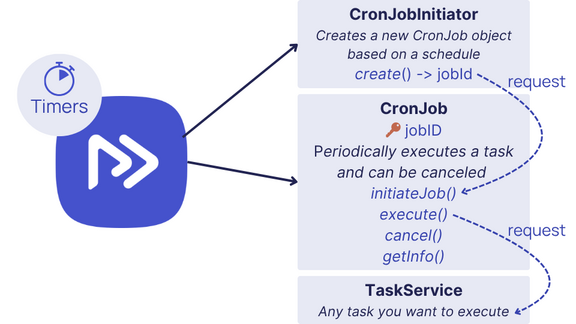 Bind both services to your endpoint, and register them.
Usage:
* Send requests to `CronJobInitiator.create()` to start new jobs with standard [cron expressions](https://www.baeldung.com/cron-expressions):
```json theme={null}
{
"cronExpression": "0 0 * * *", # E.g. run every day at midnight
"service": "TaskService", # Schedule any Restate handler
"method": "executeTask",
"key": "taskId", # Optional, Virtual Object key
"payload": "Hello midnight!"
}
```
* Each job gets a unique ID and runs as a CronJob Virtual Object.
* Jobs automatically reschedule themselves after each execution.
This pattern is implementable with any of our SDKs. We are still working on translating all patterns to all SDK languages.
If you need help with a specific language, please reach out to us via [Discord](https://discord.restate.dev) or [Slack](https://slack.restate.dev).
## Running the example
```bash TypeScript theme={null}
restate example typescript-patterns-use-cases && cd typescript-patterns-use-cases
```
```bash Java theme={null}
restate example java-patterns-use-cases && cd java-patterns-use-cases
```
```bash Go theme={null}
restate example go-patterns-use-cases && cd go-patterns-use-cases
```
```bash theme={null}
restate-server
```
```bash TypeScript theme={null}
npm install
npx tsx watch ./src/cron/task_service.ts
```
```bash Java theme={null}
./gradlew -PmainClass=my.example.cron.TaskService run
```
```bash Go theme={null}
go run ./src/cron
```
```bash theme={null}
restate deployments register localhost:9080
```
For example, run `executeTask` every minute:
```bash TypeScript theme={null}
curl localhost:8080/restate/call/CronJobInitiator/create --json '{
"cronExpression": "* * * * *",
"service": "TaskService",
"method": "executeTask",
"payload": "Hello new minute!"
}'
```
```bash Java theme={null}
curl localhost:8080/restate/call/CronJobInitiator/create --json '{
"cronExpression": "* * * * *",
"service": "TaskService",
"method": "executeTask",
"payload": "Hello new minute!"
}'
```
```bash Go theme={null}
curl localhost:8080/restate/call/CronJobInitiator/Create --json '{
"cronExpression": "* * * * *",
"service": "TaskService",
"method": "ExecuteTask",
"payload": "Hello new minute!"
}'
```
For example, or run `executeTask` at midnight:
```bash TypeScript theme={null}
curl localhost:8080/restate/call/CronJobInitiator/create --json '{
"cronExpression": "0 0 * * *",
"service": "TaskService",
"method": "executeTask",
"payload": "Hello midnight!"
}'
```
```bash Java theme={null}
curl localhost:8080/restate/call/CronJobInitiator/create --json '{
"cronExpression": "0 0 * * *",
"service": "TaskService",
"method": "executeTask",
"payload": "Hello midnight!"
}'
```
```bash Go theme={null}
curl localhost:8080/restate/call/CronJobInitiator/Create --json '{
"cronExpression": "0 0 * * *",
"service": "TaskService",
"method": "ExecuteTask",
"payload": "Hello midnight!"
}'
```
You can also use the cron service to execute handlers on Virtual Objects, by specifying the Virtual Object key in the request.
You will get back a response with the job ID.
Using the job ID, you can then get information about the job:
```bash TypeScript theme={null}
curl localhost:8080/restate/call/CronJob/myJobId/getInfo
```
```bash Java theme={null}
curl localhost:8080/restate/call/CronJob/myJobId/getInfo
```
```bash Go theme={null}
curl localhost:8080/restate/call/CronJob/myJobId/GetInfo
```
Or cancel the job later:
```bash TypeScript theme={null}
curl localhost:8080/restate/call/CronJob/myJobId/cancel
```
```bash Java theme={null}
curl localhost:8080/restate/call/CronJob/myJobId/cancel
```
```bash Go theme={null}
curl localhost:8080/restate/call/CronJob/myJobId/Cancel
```
In the UI, you can see how the tasks are scheduled, and how the state of the cron jobs is stored in Restate.
Bind both services to your endpoint, and register them.
Usage:
* Send requests to `CronJobInitiator.create()` to start new jobs with standard [cron expressions](https://www.baeldung.com/cron-expressions):
```json theme={null}
{
"cronExpression": "0 0 * * *", # E.g. run every day at midnight
"service": "TaskService", # Schedule any Restate handler
"method": "executeTask",
"key": "taskId", # Optional, Virtual Object key
"payload": "Hello midnight!"
}
```
* Each job gets a unique ID and runs as a CronJob Virtual Object.
* Jobs automatically reschedule themselves after each execution.
This pattern is implementable with any of our SDKs. We are still working on translating all patterns to all SDK languages.
If you need help with a specific language, please reach out to us via [Discord](https://discord.restate.dev) or [Slack](https://slack.restate.dev).
## Running the example
```bash TypeScript theme={null}
restate example typescript-patterns-use-cases && cd typescript-patterns-use-cases
```
```bash Java theme={null}
restate example java-patterns-use-cases && cd java-patterns-use-cases
```
```bash Go theme={null}
restate example go-patterns-use-cases && cd go-patterns-use-cases
```
```bash theme={null}
restate-server
```
```bash TypeScript theme={null}
npm install
npx tsx watch ./src/cron/task_service.ts
```
```bash Java theme={null}
./gradlew -PmainClass=my.example.cron.TaskService run
```
```bash Go theme={null}
go run ./src/cron
```
```bash theme={null}
restate deployments register localhost:9080
```
For example, run `executeTask` every minute:
```bash TypeScript theme={null}
curl localhost:8080/restate/call/CronJobInitiator/create --json '{
"cronExpression": "* * * * *",
"service": "TaskService",
"method": "executeTask",
"payload": "Hello new minute!"
}'
```
```bash Java theme={null}
curl localhost:8080/restate/call/CronJobInitiator/create --json '{
"cronExpression": "* * * * *",
"service": "TaskService",
"method": "executeTask",
"payload": "Hello new minute!"
}'
```
```bash Go theme={null}
curl localhost:8080/restate/call/CronJobInitiator/Create --json '{
"cronExpression": "* * * * *",
"service": "TaskService",
"method": "ExecuteTask",
"payload": "Hello new minute!"
}'
```
For example, or run `executeTask` at midnight:
```bash TypeScript theme={null}
curl localhost:8080/restate/call/CronJobInitiator/create --json '{
"cronExpression": "0 0 * * *",
"service": "TaskService",
"method": "executeTask",
"payload": "Hello midnight!"
}'
```
```bash Java theme={null}
curl localhost:8080/restate/call/CronJobInitiator/create --json '{
"cronExpression": "0 0 * * *",
"service": "TaskService",
"method": "executeTask",
"payload": "Hello midnight!"
}'
```
```bash Go theme={null}
curl localhost:8080/restate/call/CronJobInitiator/Create --json '{
"cronExpression": "0 0 * * *",
"service": "TaskService",
"method": "ExecuteTask",
"payload": "Hello midnight!"
}'
```
You can also use the cron service to execute handlers on Virtual Objects, by specifying the Virtual Object key in the request.
You will get back a response with the job ID.
Using the job ID, you can then get information about the job:
```bash TypeScript theme={null}
curl localhost:8080/restate/call/CronJob/myJobId/getInfo
```
```bash Java theme={null}
curl localhost:8080/restate/call/CronJob/myJobId/getInfo
```
```bash Go theme={null}
curl localhost:8080/restate/call/CronJob/myJobId/GetInfo
```
Or cancel the job later:
```bash TypeScript theme={null}
curl localhost:8080/restate/call/CronJob/myJobId/cancel
```
```bash Java theme={null}
curl localhost:8080/restate/call/CronJob/myJobId/cancel
```
```bash Go theme={null}
curl localhost:8080/restate/call/CronJob/myJobId/Cancel
```
In the UI, you can see how the tasks are scheduled, and how the state of the cron jobs is stored in Restate.

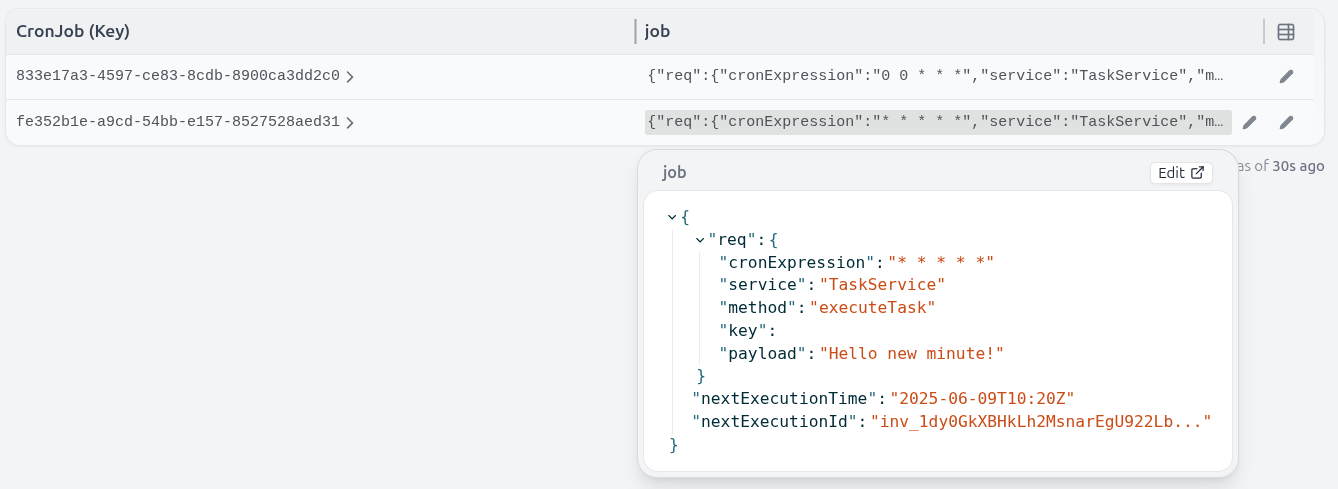 You can kill and restart any of the services or the Restate Server, and the scheduled tasks will still be there.
## Adapt to your use case
Note that this implementation is fully resilient, but you might need to make some adjustments to make this fit your use case:
* Take into account time zones.
* Adjust how you want to handle tasks that fail until the next task gets scheduled. With the current implementation, you would have concurrent executions of the same cron job (one retrying and the other starting up).
If you want to cancel the failing task when a new one needs to start, you can do the following: at the beginning of the `execute` call, retrieve the `next_execution_id` from the job state and check if it is completed by [attaching to it](/develop/ts/service-communication#re-attach-to-an-invocation) with [a timeout set to 0](/develop/ts/durable-timers#timers-and-timeouts). If it is not completed, [cancel it](/develop/ts/service-communication#cancel-an-invocation) and start the new iteration.
You can kill and restart any of the services or the Restate Server, and the scheduled tasks will still be there.
## Adapt to your use case
Note that this implementation is fully resilient, but you might need to make some adjustments to make this fit your use case:
* Take into account time zones.
* Adjust how you want to handle tasks that fail until the next task gets scheduled. With the current implementation, you would have concurrent executions of the same cron job (one retrying and the other starting up).
If you want to cancel the failing task when a new one needs to start, you can do the following: at the beginning of the `execute` call, retrieve the `next_execution_id` from the job state and check if it is completed by [attaching to it](/develop/ts/service-communication#re-attach-to-an-invocation) with [a timeout set to 0](/develop/ts/durable-timers#timers-and-timeouts). If it is not completed, [cancel it](/develop/ts/service-communication#cancel-an-invocation) and start the new iteration.