> ## Documentation Index
> Fetch the complete documentation index at: https://docs.restate.dev/llms.txt
> Use this file to discover all available pages before exploring further.
# Microservice Orchestration
> Learn how to orchestrate microservices with durable execution, sagas, and async communication patterns.
export const GitHubLink = ({url}) => ;
Microservice orchestration is about coordinating multiple services to complete complex business workflows. Restate provides powerful primitives for building resilient, observable orchestration patterns.
In this guide, you'll learn how to:
* Build durable, fault-tolerant service orchestrations with automatic failure recovery
* Implement sagas for distributed transactions with resilient compensation
* Use durable timers and external events for complex async patterns
* Implement stateful entities with Virtual Objects
## Getting Started
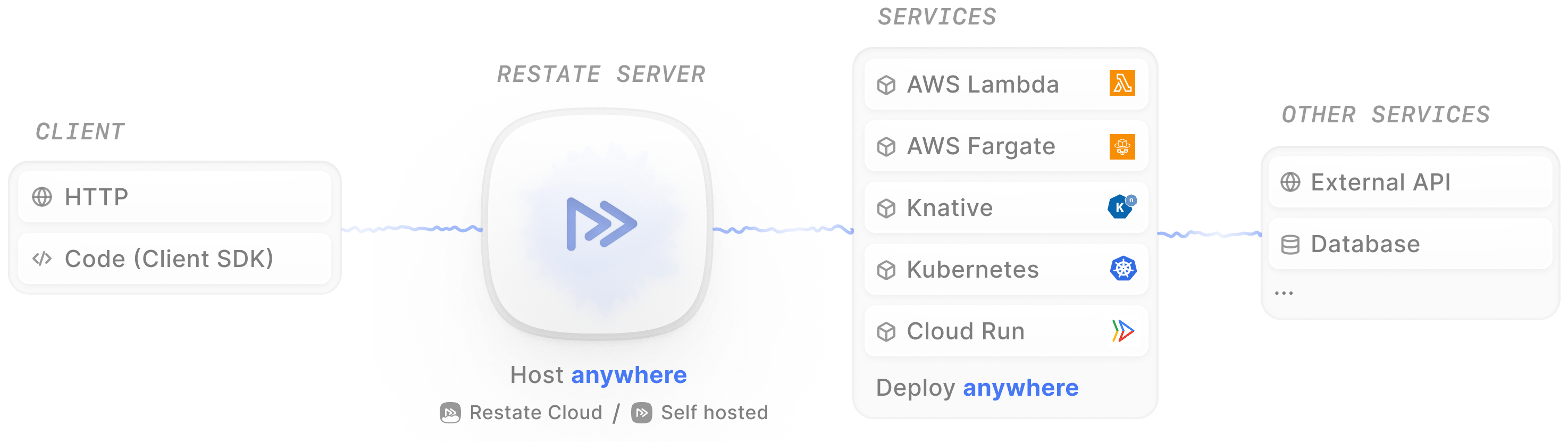
A Restate application is composed of two main components:
* **Restate Server**: The core engine that manages durable execution and orchestrates services. It acts as a message broker or reverse proxy in front of your services.
* **Your Services**: Your business logic, implemented as service handlers using the Restate SDK to perform durable operations.
 A basic subscription service orchestration looks like this:
```ts src/getstarted/service.ts {"CODE_LOAD::https://raw.githubusercontent.com/restatedev/examples/refs/heads/main/typescript/tutorials/tour-of-orchestration-typescript/src/getstarted/service.ts?collapse_prequel"} theme={null}
export const subscriptionService = restate.service({
name: "SubscriptionService",
handlers: {
add: async (ctx: Context, req: SubscriptionRequest) => {
const paymentId = ctx.rand.uuidv4();
const payRef = await ctx.run("pay", () =>
createRecurringPayment(req.creditCard, paymentId),
);
for (const subscription of req.subscriptions) {
await ctx.run(`add-${subscription}`, () =>
createSubscription(req.userId, subscription, payRef),
);
}
},
},
});
```
```java getstarted/SubscriptionService.java {"CODE_LOAD::https://raw.githubusercontent.com/restatedev/examples/refs/heads/main/java/tutorials/tour-of-orchestration-java/src/main/java/my/example/getstarted/SubscriptionService.java?collapse_prequel"} theme={null}
@Service
public class SubscriptionService {
@Handler
public void add(Context ctx, SubscriptionRequest req) {
var paymentId = ctx.random().nextUUID().toString();
String payRef =
ctx.run("pay", String.class, () -> createRecurringPayment(req.creditCard(), paymentId));
for (String subscription : req.subscriptions()) {
ctx.run("add-" + subscription, () -> createSubscription(req.userId(), subscription, payRef));
}
}
}
```
```go getstarted.go {"CODE_LOAD::https://raw.githubusercontent.com/restatedev/examples/refs/heads/main/go/tutorials/tour-of-orchestration-go/examples/getstarted.go?collapse_prequel"} theme={null}
type SubscriptionService struct{}
func (SubscriptionService) Add(ctx restate.Context, req SubscriptionRequest) error {
paymentId := restate.UUID(ctx).String()
payRef, err := restate.Run(ctx, func(ctx restate.RunContext) (string, error) {
return CreateRecurringPayment(req.CreditCard, paymentId)
}, restate.WithName("pay"))
if err != nil {
return err
}
for _, subscription := range req.Subscriptions {
_, err := restate.Run(ctx, func(ctx restate.RunContext) (string, error) {
return CreateSubscription(req.UserId, subscription, payRef)
}, restate.WithName(fmt.Sprintf("add-%s", subscription)))
if err != nil {
return err
}
}
return nil
}
```
```python app/getstarted/service.py {"CODE_LOAD::https://raw.githubusercontent.com/restatedev/examples/refs/heads/main/python/tutorials/tour-of-orchestration-python/app/getstarted/service.py?collapse_prequel"} theme={null}
subscription_service = restate.Service("SubscriptionService")
@subscription_service.handler()
async def add(ctx: restate.Context, req: SubscriptionRequest) -> None:
payment_id = str(ctx.uuid())
pay_ref = await ctx.run_typed(
"pay",
create_recurring_payment,
credit_card=req.credit_card,
payment_id=payment_id,
)
for subscription in req.subscriptions:
await ctx.run_typed(
f"add-{subscription}",
create_subscription,
user_id=req.user_id,
subscription=subscription,
payment_ref=pay_ref,
)
```
A service has handlers that can be called over HTTP. Each handler receives a `Context` object that provides durable execution primitives. Any action performed with the Context is automatically recorded and can survive failures.
You don't need to run your services in any special way. Restate works with how you already deploy your code, whether that's in Docker, on Kubernetes, or via AWS Lambda.
A basic subscription service orchestration looks like this:
```ts src/getstarted/service.ts {"CODE_LOAD::https://raw.githubusercontent.com/restatedev/examples/refs/heads/main/typescript/tutorials/tour-of-orchestration-typescript/src/getstarted/service.ts?collapse_prequel"} theme={null}
export const subscriptionService = restate.service({
name: "SubscriptionService",
handlers: {
add: async (ctx: Context, req: SubscriptionRequest) => {
const paymentId = ctx.rand.uuidv4();
const payRef = await ctx.run("pay", () =>
createRecurringPayment(req.creditCard, paymentId),
);
for (const subscription of req.subscriptions) {
await ctx.run(`add-${subscription}`, () =>
createSubscription(req.userId, subscription, payRef),
);
}
},
},
});
```
```java getstarted/SubscriptionService.java {"CODE_LOAD::https://raw.githubusercontent.com/restatedev/examples/refs/heads/main/java/tutorials/tour-of-orchestration-java/src/main/java/my/example/getstarted/SubscriptionService.java?collapse_prequel"} theme={null}
@Service
public class SubscriptionService {
@Handler
public void add(Context ctx, SubscriptionRequest req) {
var paymentId = ctx.random().nextUUID().toString();
String payRef =
ctx.run("pay", String.class, () -> createRecurringPayment(req.creditCard(), paymentId));
for (String subscription : req.subscriptions()) {
ctx.run("add-" + subscription, () -> createSubscription(req.userId(), subscription, payRef));
}
}
}
```
```go getstarted.go {"CODE_LOAD::https://raw.githubusercontent.com/restatedev/examples/refs/heads/main/go/tutorials/tour-of-orchestration-go/examples/getstarted.go?collapse_prequel"} theme={null}
type SubscriptionService struct{}
func (SubscriptionService) Add(ctx restate.Context, req SubscriptionRequest) error {
paymentId := restate.UUID(ctx).String()
payRef, err := restate.Run(ctx, func(ctx restate.RunContext) (string, error) {
return CreateRecurringPayment(req.CreditCard, paymentId)
}, restate.WithName("pay"))
if err != nil {
return err
}
for _, subscription := range req.Subscriptions {
_, err := restate.Run(ctx, func(ctx restate.RunContext) (string, error) {
return CreateSubscription(req.UserId, subscription, payRef)
}, restate.WithName(fmt.Sprintf("add-%s", subscription)))
if err != nil {
return err
}
}
return nil
}
```
```python app/getstarted/service.py {"CODE_LOAD::https://raw.githubusercontent.com/restatedev/examples/refs/heads/main/python/tutorials/tour-of-orchestration-python/app/getstarted/service.py?collapse_prequel"} theme={null}
subscription_service = restate.Service("SubscriptionService")
@subscription_service.handler()
async def add(ctx: restate.Context, req: SubscriptionRequest) -> None:
payment_id = str(ctx.uuid())
pay_ref = await ctx.run_typed(
"pay",
create_recurring_payment,
credit_card=req.credit_card,
payment_id=payment_id,
)
for subscription in req.subscriptions:
await ctx.run_typed(
f"add-{subscription}",
create_subscription,
user_id=req.user_id,
subscription=subscription,
payment_ref=pay_ref,
)
```
A service has handlers that can be called over HTTP. Each handler receives a `Context` object that provides durable execution primitives. Any action performed with the Context is automatically recorded and can survive failures.
You don't need to run your services in any special way. Restate works with how you already deploy your code, whether that's in Docker, on Kubernetes, or via AWS Lambda.
The endpoint that serves the services of this tour over HTTP is defined in `src/app.ts`.
The endpoint that serves the services of this tour over HTTP is defined in `AppMain.java`.
The endpoint that serves the services of this tour over HTTP is defined in `main.go`.
The endpoint that serves the services of this tour over HTTP is defined in `__main__.py`.
### Run the example
[Install Restate](/installation) and launch it:
```bash theme={null}
restate-server
```
Get the example:
```bash theme={null}
restate example typescript-tour-of-orchestration && cd typescript-tour-of-orchestration
npm install
```
Run the example:
```bash theme={null}
npm run dev
```
Then, tell Restate where your services are running via the UI (`http://localhost:9070`) or CLI:
```bash theme={null}
restate deployments register http://localhost:9080
```
This registers a set of services that we will be covering in this tutorial.
To invoke a handler, send a request to `restate-ingress/MyServiceName/handlerName`:
```bash theme={null}
curl localhost:8080/restate/call/SubscriptionService/add \
--json '{"userId": "user-123", "creditCard": "4111111111111111", "subscriptions": ["Hulu", "Prime"]}'
```
Get the example:
```bash theme={null}
restate example java-tour-of-orchestration && cd java-tour-of-orchestration
```
Run the example:
```bash theme={null}
./gradlew run
```
Then, tell Restate where your services are running via the UI (`http://localhost:9070`) or CLI:
```bash theme={null}
restate deployments register http://localhost:9080
```
This registers a set of services that we will be covering in this tutorial.
To invoke a handler, send a request to `restate-ingress/MyServiceName/handlerName`:
```bash theme={null}
curl localhost:8080/restate/call/SubscriptionService/add \
--json '{"userId": "user-123", "creditCard": "4111111111111111", "subscriptions": ["Hulu", "Prime"]}'
```
Get the example:
```bash theme={null}
restate example go-tour-of-orchestration && cd go-tour-of-orchestration
```
Run the example:
```bash theme={null}
go run .
```
Then, tell Restate where your services are running via the UI (`http://localhost:9070`) or CLI:
```bash theme={null}
restate deployments register http://localhost:9080
```
This registers a set of services that we will be covering in this tutorial.
To invoke a handler, send a request to `restate-ingress/MyServiceName/handlerName`:
```bash theme={null}
curl localhost:8080/restate/call/SubscriptionService/Add \
--json '{"userId": "user-123", "creditCard": "4111111111111111", "subscriptions": ["Hulu", "Prime"]}'
```
Get the example:
```bash theme={null}
restate example python-tour-of-orchestration && cd python-tour-of-orchestration
```
Run the example:
```bash theme={null}
uv run .
```
Then, tell Restate where your services are running via the UI (`http://localhost:9070`) or CLI:
```bash theme={null}
restate deployments register http://localhost:9080
```
This registers a set of services that we will be covering in this tutorial.
To invoke a handler, send a request to `restate-ingress/MyServiceName/handlerName`:
```bash theme={null}
curl localhost:8080/restate/call/SubscriptionService/add \
--json '{"userId": "user-123", "creditCard": "4111111111111111", "subscriptions": ["Hulu", "Prime"]}'
```
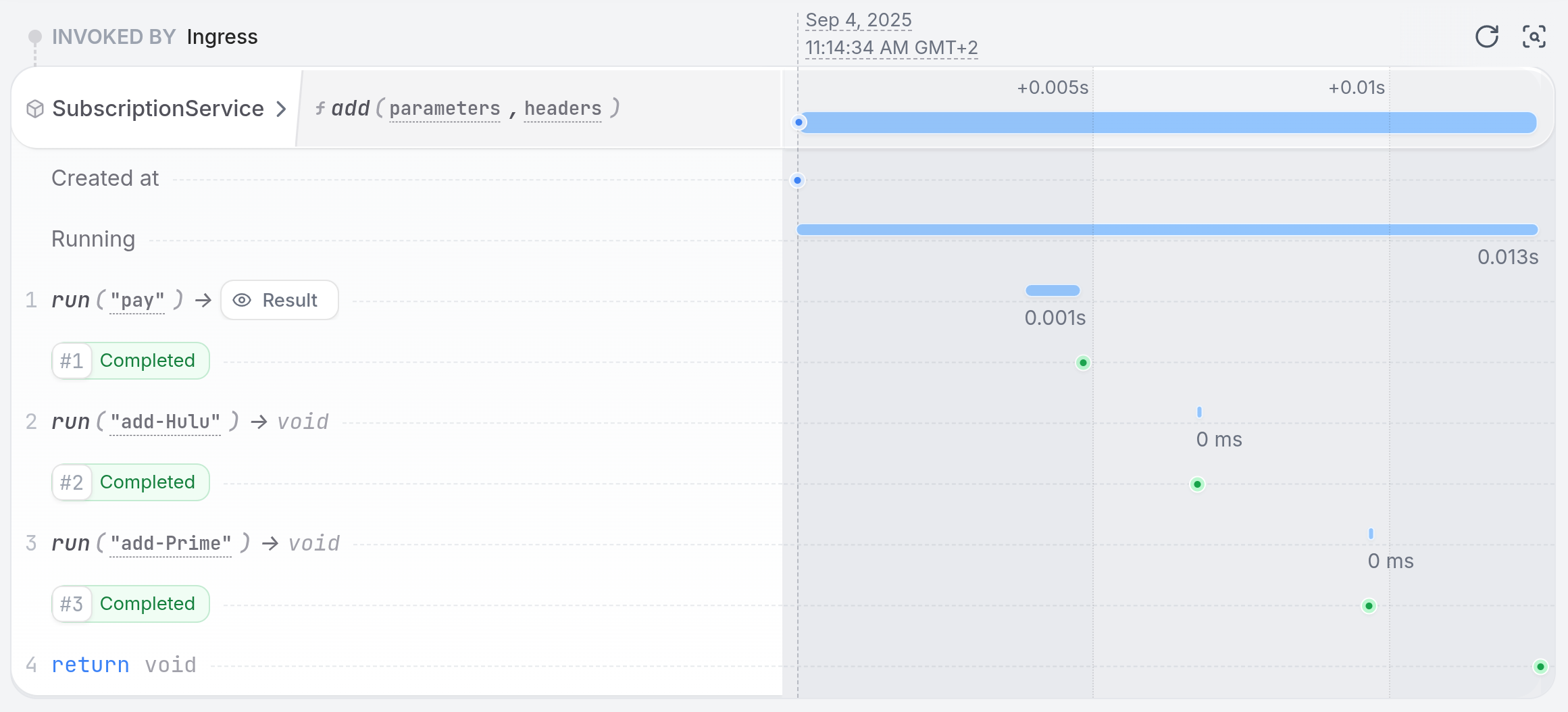
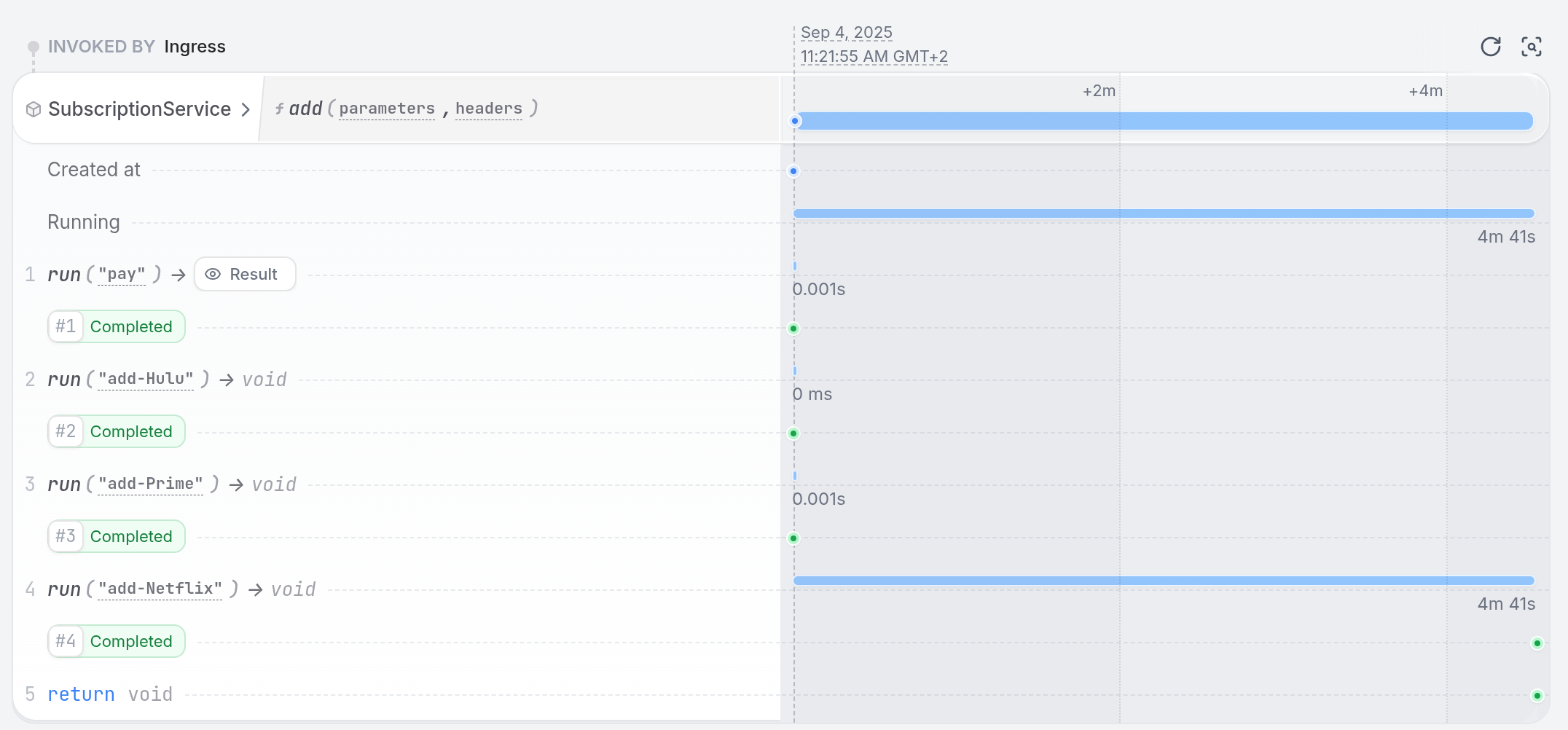
Click in the UI's invocations tab on the inovcation ID of your request to see the execution trace of your request.
 ## Durable Execution
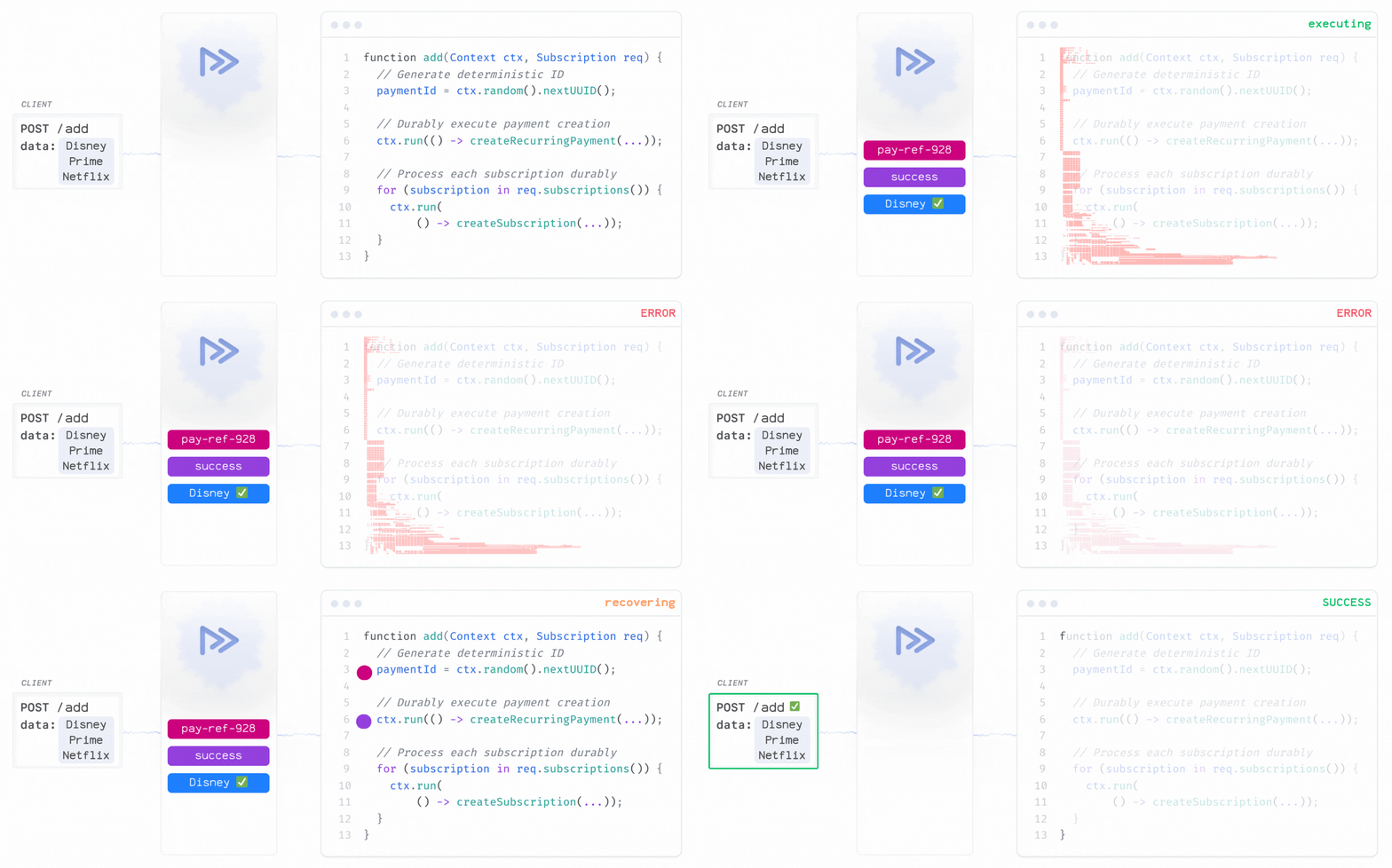
Restate uses Durable Execution to ensure your orchestration logic survives failures and restarts.
Whenever a handler executes an action with the Restate `Context`, this gets send over to the Restate Server and persisted in a log.
On a failure or a crash, the Restate Server sends a retry request that contains the log of the actions that were executed so far.
The service then replays the log to restore state and continues executing the remaining actions.
This process continues until the handler runs till completion.
## Durable Execution
Restate uses Durable Execution to ensure your orchestration logic survives failures and restarts.
Whenever a handler executes an action with the Restate `Context`, this gets send over to the Restate Server and persisted in a log.
On a failure or a crash, the Restate Server sends a retry request that contains the log of the actions that were executed so far.
The service then replays the log to restore state and continues executing the remaining actions.
This process continues until the handler runs till completion.
 **Key Benefits:**
* Context `run` actions make external calls or non-deterministic operations durable. They get replayed on failures.
* If the service crashes after payment creation, it resumes at the subscription step
* Deterministic IDs logged with the context ensure operations are idempotent
* Full execution traces for debugging and monitoring
**Key Benefits:**
* Context `run` actions make external calls or non-deterministic operations durable. They get replayed on failures.
* If the service crashes after payment creation, it resumes at the subscription step
* Deterministic IDs logged with the context ensure operations are idempotent
* Full execution traces for debugging and monitoring
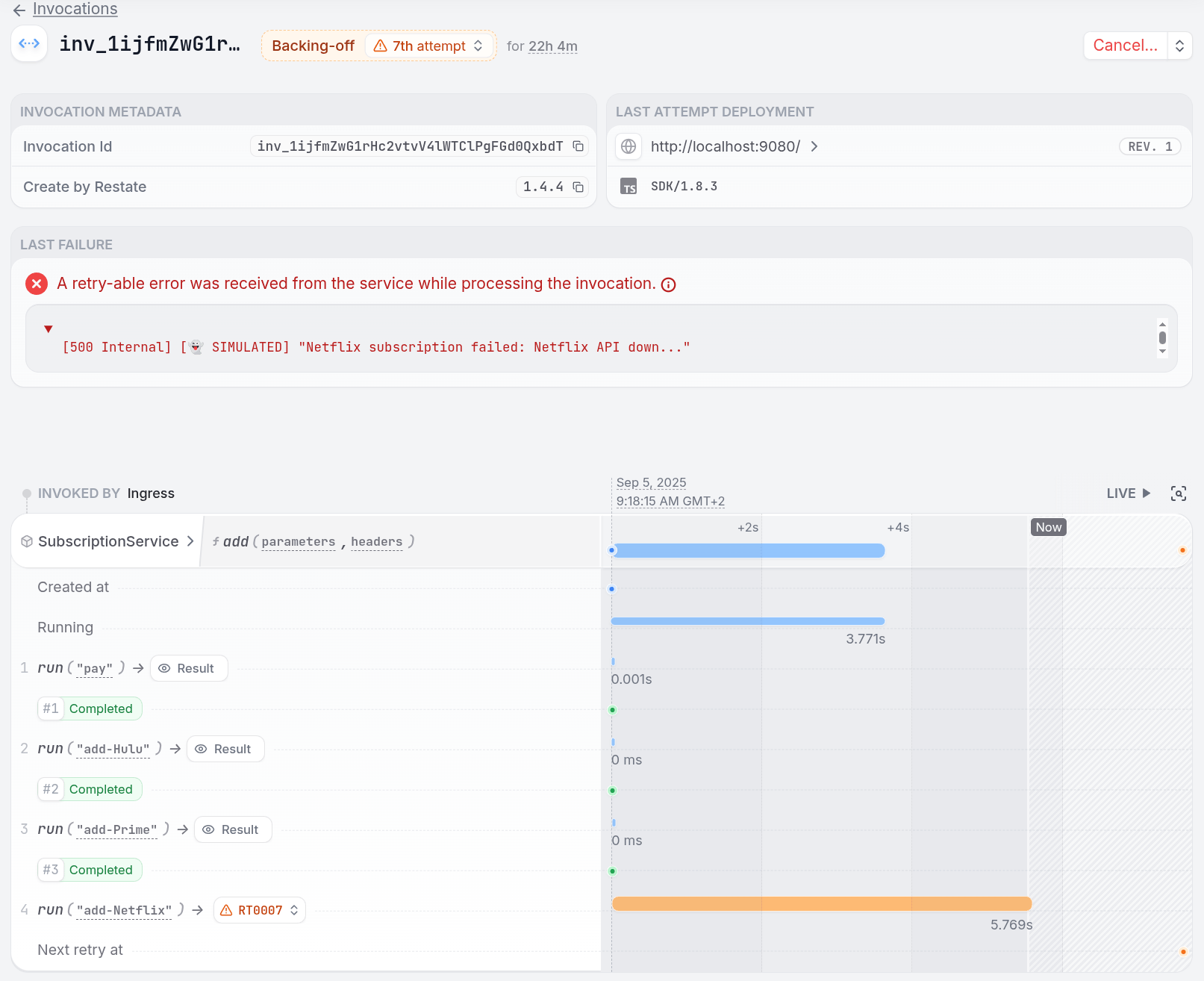
Try to add a subscription for Netflix:
```bash theme={null}
curl localhost:8080/restate/call/SubscriptionService/add \
--json '{"userId": "user-123", "creditCard": "4111111111111111", "subscriptions": ["Hulu", "Prime", "Netflix"]}'
```
On the invocation page in the UI, you can see that your request is retrying because the Netflix API is down:
 To fix the problem, remove the line `failOnNetflix` from the `createSubscription` function in the `utils.ts` file:
```ts {"CODE_LOAD::https://raw.githubusercontent.com/restatedev/examples/refs/heads/main/typescript/tutorials/tour-of-orchestration-typescript/src/utils.ts#subscription"} theme={null}
export function createSubscription(
userId: string,
subscription: string,
_paymentRef: string,
): string {
failOnNetflix(subscription);
terminalErrorOnDisney(subscription);
console.log(`>>> Created subscription ${subscription} for user ${userId}`);
return "SUCCESS";
}
```
Try to add a subscription for Netflix:
```bash theme={null}
curl localhost:8080/restate/call/SubscriptionService/add \
--json '{"userId": "user-123", "creditCard": "4111111111111111", "subscriptions": ["Hulu", "Prime", "Netflix"]}'
```
On the invocation page in the UI, you can see that your request is retrying because the Netflix API is down:
To fix the problem, remove the line `failOnNetflix` from the `createSubscription` function in the `auxiliary/clients/SubscriptionClient.java` file:
```java {"CODE_LOAD::https://raw.githubusercontent.com/restatedev/examples/refs/heads/main/java/tutorials/tour-of-orchestration-java/src/main/java/my/example/auxiliary/clients/SubscriptionClient.java#subscription"} theme={null}
public static String createSubscription(String userId, String subscription, String paymentRef) {
failOnNetflix(subscription);
terminalErrorOnDisney(subscription);
System.out.println(">>> Created subscription " + subscription + " for user " + userId);
return "SUCCESS";
}
```
Try to add a subscription for Netflix:
```bash theme={null}
curl localhost:8080/restate/call/SubscriptionService/Add \
--json '{"userId": "user-123", "creditCard": "4111111111111111", "subscriptions": ["Hulu", "Prime", "Netflix"]}'
```
On the invocation page in the UI, you can see that your request is retrying because the Netflix API is down:
To fix the problem, remove the line `failOnNetflix` from the `CreateSubscription` function in the `utils.go` file:
```go {"CODE_LOAD::https://raw.githubusercontent.com/restatedev/examples/refs/heads/main/go/tutorials/tour-of-orchestration-go/examples/utils.go#subscription"} theme={null}
func CreateSubscription(userId, subscription, paymentRef string) (string, error) {
if err := failOnNetflix(subscription); err != nil {
return "", err
}
if err := terminalErrorOnDisney(subscription); err != nil {
return "", err
}
fmt.Printf(">>> Created subscription %s for user %s\n", subscription, userId)
return "SUCCESS", nil
}
```
Try to add a subscription for Netflix:
```bash theme={null}
curl localhost:8080/restate/call/SubscriptionService/add \
--json '{"userId": "user-123", "creditCard": "4111111111111111", "subscriptions": ["Hulu", "Prime", "Netflix"]}'
```
On the invocation page in the UI, you can see that your request is retrying because the Netflix API is down:
To fix the problem, remove the line `fail_on_netflix` from the `create_subscription` function in the `utils.py` file:
```python {"CODE_LOAD::https://raw.githubusercontent.com/restatedev/examples/refs/heads/main/python/tutorials/tour-of-orchestration-python/app/utils.py#subscription"} theme={null}
def create_subscription(user_id: str, subscription: str, payment_ref: str) -> str:
fail_on_netflix(subscription)
terminal_error_on_disney(subscription)
print(f">>> Created subscription {subscription} for user {user_id}")
return "SUCCESS"
```
To fix the problem, remove the line `failOnNetflix` from the `createSubscription` function in the `utils.ts` file:
```ts {"CODE_LOAD::https://raw.githubusercontent.com/restatedev/examples/refs/heads/main/typescript/tutorials/tour-of-orchestration-typescript/src/utils.ts#subscription"} theme={null}
export function createSubscription(
userId: string,
subscription: string,
_paymentRef: string,
): string {
failOnNetflix(subscription);
terminalErrorOnDisney(subscription);
console.log(`>>> Created subscription ${subscription} for user ${userId}`);
return "SUCCESS";
}
```
Try to add a subscription for Netflix:
```bash theme={null}
curl localhost:8080/restate/call/SubscriptionService/add \
--json '{"userId": "user-123", "creditCard": "4111111111111111", "subscriptions": ["Hulu", "Prime", "Netflix"]}'
```
On the invocation page in the UI, you can see that your request is retrying because the Netflix API is down:
To fix the problem, remove the line `failOnNetflix` from the `createSubscription` function in the `auxiliary/clients/SubscriptionClient.java` file:
```java {"CODE_LOAD::https://raw.githubusercontent.com/restatedev/examples/refs/heads/main/java/tutorials/tour-of-orchestration-java/src/main/java/my/example/auxiliary/clients/SubscriptionClient.java#subscription"} theme={null}
public static String createSubscription(String userId, String subscription, String paymentRef) {
failOnNetflix(subscription);
terminalErrorOnDisney(subscription);
System.out.println(">>> Created subscription " + subscription + " for user " + userId);
return "SUCCESS";
}
```
Try to add a subscription for Netflix:
```bash theme={null}
curl localhost:8080/restate/call/SubscriptionService/Add \
--json '{"userId": "user-123", "creditCard": "4111111111111111", "subscriptions": ["Hulu", "Prime", "Netflix"]}'
```
On the invocation page in the UI, you can see that your request is retrying because the Netflix API is down:
To fix the problem, remove the line `failOnNetflix` from the `CreateSubscription` function in the `utils.go` file:
```go {"CODE_LOAD::https://raw.githubusercontent.com/restatedev/examples/refs/heads/main/go/tutorials/tour-of-orchestration-go/examples/utils.go#subscription"} theme={null}
func CreateSubscription(userId, subscription, paymentRef string) (string, error) {
if err := failOnNetflix(subscription); err != nil {
return "", err
}
if err := terminalErrorOnDisney(subscription); err != nil {
return "", err
}
fmt.Printf(">>> Created subscription %s for user %s\n", subscription, userId)
return "SUCCESS", nil
}
```
Try to add a subscription for Netflix:
```bash theme={null}
curl localhost:8080/restate/call/SubscriptionService/add \
--json '{"userId": "user-123", "creditCard": "4111111111111111", "subscriptions": ["Hulu", "Prime", "Netflix"]}'
```
On the invocation page in the UI, you can see that your request is retrying because the Netflix API is down:
To fix the problem, remove the line `fail_on_netflix` from the `create_subscription` function in the `utils.py` file:
```python {"CODE_LOAD::https://raw.githubusercontent.com/restatedev/examples/refs/heads/main/python/tutorials/tour-of-orchestration-python/app/utils.py#subscription"} theme={null}
def create_subscription(user_id: str, subscription: str, payment_ref: str) -> str:
fail_on_netflix(subscription)
terminal_error_on_disney(subscription)
print(f">>> Created subscription {subscription} for user {user_id}")
return "SUCCESS"
```
Once you restart the service, the workflow finishes successfully:
 ## Error Handling
By default, Restate retries failures infinitely with an exponential backoff strategy.
For some failures, you might not want to retry or only retry a limited number of times.
For these cases, Restate distinguishes between two types of errors:
* **Transient Errors**: These are temporary issues that can be retried, such as network timeouts or service unavailability. Restate automatically retries these errors.
* **Terminal Errors**: These indicate a failure that will not be retried, such as invalid input or business logic violations. Restate stops execution and allows you to handle these errors gracefully.
Throw a terminal error in your handler to indicate a terminal failure:
## Error Handling
By default, Restate retries failures infinitely with an exponential backoff strategy.
For some failures, you might not want to retry or only retry a limited number of times.
For these cases, Restate distinguishes between two types of errors:
* **Transient Errors**: These are temporary issues that can be retried, such as network timeouts or service unavailability. Restate automatically retries these errors.
* **Terminal Errors**: These indicate a failure that will not be retried, such as invalid input or business logic violations. Restate stops execution and allows you to handle these errors gracefully.
Throw a terminal error in your handler to indicate a terminal failure:
```typescript {"CODE_LOAD::ts/src/tour/microservices/terminal_error.ts#terminal_error"} theme={null}
throw new TerminalError("Invalid credit card");
```
```java {"CODE_LOAD::java/src/main/java/tour/microservices/ErrorHandler.java#here"} theme={null}
throw new TerminalException("Invalid credit card");
```
```go {"CODE_LOAD::go/tour/microservices/errorhandling.go#here"} theme={null}
return restate.ToTerminalError(fmt.Errorf("invalid credit card"))
```
```python {"CODE_LOAD::python/src/tour/microservices/terminal_error.py#here"} theme={null}
from restate.exceptions import TerminalError
raise TerminalError("Invalid credit card")
```
Some actions let you configure their retry behavior, for example to limit the number of retries of a run block:
```ts {"CODE_LOAD::ts/src/tour/microservices/retries.ts#retries"} theme={null}
const retryPolicy = {
maxRetryAttempts: 3,
initialRetryIntervalMillis: 1000,
};
const payRef = await ctx.run(
"pay",
() => createRecurringPayment(req.creditCard, paymentId),
retryPolicy
);
```
```java {"CODE_LOAD::java/src/main/java/tour/microservices/Retries.java#here"} theme={null}
RetryPolicy myRunRetryPolicy =
RetryPolicy.defaultPolicy().setInitialDelay(Duration.ofSeconds(1)).setMaxAttempts(3);
String payRef =
ctx.run(
"pay",
String.class,
myRunRetryPolicy,
() -> createRecurringPayment(req.creditCard(), paymentId));
```
```go {"CODE_LOAD::go/tour/microservices/retries.go#here"} theme={null}
result, err := restate.Run(ctx,
func(ctx restate.RunContext) (string, error) {
return createRecurringPayment(req.CreditCard, paymentId)
},
restate.WithInitialRetryInterval(time.Millisecond*100),
restate.WithMaxRetryAttempts(3),
restate.WithName("pay"),
)
if err != nil {
return err
}
```
```python {"CODE_LOAD::python/src/tour/microservices/retries.py#here"} theme={null}
pay_ref = await ctx.run_typed(
"pay",
lambda: create_recurring_payment(req["creditCard"], payment_id),
restate.RunOptions(max_attempts=10, max_retry_duration=timedelta(seconds=30)),
)
```
When the retries are exhausted, the run block will throw a `TerminalError`, that you can handle in your handler logic.
Learn more with the [Error Handling Guide](/guides/error-handling).
## Sagas and Rollback
On a terminal failure, Restate stops the execution of the handler.
You might, however, want to roll back the changes made by the workflow to keep your system in a consistent state.
This is where Sagas come in.
Sagas are a pattern for rolling back changes made by a handler when it fails.
In Restate, you can implement a saga by building a list of compensating actions for each step of the workflow.
On a terminal failure, you execute them in reverse order:
```ts src/sagas/service.ts {"CODE_LOAD::https://raw.githubusercontent.com/restatedev/examples/refs/heads/main/typescript/tutorials/tour-of-orchestration-typescript/src/sagas/service.ts?collapse_prequel"} theme={null}
export const subscriptionSaga = restate.service({
name: "SubscriptionSaga",
handlers: {
add: async (ctx: Context, req: SubscriptionRequest) => {
const compensations = [];
try {
const paymentId = ctx.rand.uuidv4();
compensations.push(() =>
ctx.run("undo-pay", () => removeRecurringPayment(paymentId)),
);
const payRef = await ctx.run("pay", () =>
createRecurringPayment(req.creditCard, paymentId),
);
for (const subscription of req.subscriptions) {
compensations.push(() =>
ctx.run(`undo-${subscription}`, () =>
removeSubscription(req.userId, subscription),
),
);
await ctx.run(`add-${subscription}`, () =>
createSubscription(req.userId, subscription, payRef),
);
}
} catch (e) {
if (e instanceof restate.TerminalError) {
for (const compensation of compensations.reverse()) {
await compensation();
}
}
throw e;
}
},
},
});
```
```java sagas/SubscriptionSaga.java {"CODE_LOAD::https://raw.githubusercontent.com/restatedev/examples/refs/heads/main/java/tutorials/tour-of-orchestration-java/src/main/java/my/example/sagas/SubscriptionSaga.java?collapse_prequel"} theme={null}
@Service
public class SubscriptionSaga {
@Handler
public void add(Context ctx, SubscriptionRequest req) {
List compensations = new ArrayList<>();
try {
var paymentId = ctx.random().nextUUID().toString();
compensations.add(
() -> ctx.run("undo-pay", () -> PaymentClient.removeRecurringPayment(paymentId)));
String payRef =
ctx.run(
"pay",
String.class,
() -> PaymentClient.createRecurringPayment(req.creditCard(), paymentId));
for (String subscription : req.subscriptions()) {
compensations.add(
() ->
ctx.run(
"undo-" + subscription,
() -> SubscriptionClient.removeSubscription(req.userId(), subscription)));
ctx.run(
"add-" + subscription,
() -> SubscriptionClient.createSubscription(req.userId(), subscription, payRef));
}
} catch (TerminalException e) {
// Run compensations in reverse order
Collections.reverse(compensations);
for (Runnable compensation : compensations) {
compensation.run();
}
throw e;
}
}
}
```
```go sagas.go {"CODE_LOAD::https://raw.githubusercontent.com/restatedev/examples/refs/heads/main/go/tutorials/tour-of-orchestration-go/examples/sagas.go?collapse_prequel"} theme={null}
type SubscriptionSaga struct{}
func (SubscriptionSaga) Add(ctx restate.Context, req SubscriptionRequest) (err error) {
var compensations []func() error
// Run compensations at the end if err != nil
defer func() {
if err != nil {
for _, compensation := range slices.Backward(compensations) {
if compErr := compensation(); compErr != nil {
err = compErr
}
}
}
}()
paymentId := restate.UUID(ctx).String()
// Add compensation for payment
compensations = append(compensations, func() error {
_, err := restate.Run(ctx, func(ctx restate.RunContext) (restate.Void, error) {
return RemoveRecurringPayment(paymentId)
}, restate.WithName("undo-pay"))
return err
})
// Create payment
payRef, err := restate.Run(ctx, func(ctx restate.RunContext) (string, error) {
return CreateRecurringPayment(req.CreditCard, paymentId)
}, restate.WithName("pay"))
if err != nil {
return err
}
// Process subscriptions
for _, subscription := range req.Subscriptions {
// Add compensation for this subscription
sub := subscription // Capture loop variable
compensations = append(compensations, func() error {
_, err := restate.Run(ctx, func(ctx restate.RunContext) (restate.Void, error) {
return RemoveSubscription(req.UserId, sub)
}, restate.WithName(fmt.Sprintf("undo-%s", sub)))
return err
})
// Create subscription
_, err := restate.Run(ctx, func(ctx restate.RunContext) (string, error) {
return CreateSubscription(req.UserId, subscription, payRef)
}, restate.WithName(fmt.Sprintf("add-%s", subscription)))
if err != nil {
return err
}
}
return nil
}
```
```python app/sagas/service.py {"CODE_LOAD::https://raw.githubusercontent.com/restatedev/examples/refs/heads/main/python/tutorials/tour-of-orchestration-python/app/sagas/service.py?collapse_prequel"} theme={null}
subscription_saga = restate.Service("SubscriptionSaga")
@subscription_saga.handler()
async def add(ctx: restate.Context, req: SubscriptionRequest) -> None:
compensations = []
try:
payment_id = str(ctx.uuid())
# Add compensation for payment
compensations.append(
lambda: ctx.run_typed(
"undo-pay", remove_recurring_payment, payment_id=payment_id
)
)
# Create payment
pay_ref = await ctx.run_typed(
"pay",
create_recurring_payment,
credit_card=req.credit_card,
payment_id=payment_id,
)
# Process subscriptions
for subscription in req.subscriptions:
# Add compensation for this subscription
compensations.append(
lambda s=subscription: ctx.run_typed( # type: ignore
f"undo-{s}",
remove_subscription,
user_id=req.user_id,
subscription=s,
)
)
# Create subscription
await ctx.run_typed(
f"add-{subscription}",
create_subscription,
user_id=req.user_id,
subscription=subscription,
payment_ref=pay_ref,
)
except restate.TerminalError as e:
# Run compensations in reverse order
for compensation in reversed(compensations):
await compensation()
raise e
```
**Benefits with Restate:**
* The list of compensations can be recovered after a crash, and Restate knows which compensations still need to be run.
* Sagas always run till completion (success or complete rollback)
* Full trace of all operations and compensations
* No complex state machines needed
Add a subscription for Disney:
```bash theme={null}
curl localhost:8080/restate/call/SubscriptionSaga/add \
--json '{"userId": "user-123", "creditCard": "4111111111111111", "subscriptions": ["Hulu", "Prime", "Disney"]}'
```
```bash theme={null}
curl localhost:8080/restate/call/SubscriptionSaga/add \
--json '{"userId": "user-123", "creditCard": "4111111111111111", "subscriptions": ["Hulu", "Prime", "Disney"]}'
```
```bash theme={null}
curl localhost:8080/restate/call/SubscriptionSaga/Add \
--json '{"userId": "user-123", "creditCard": "4111111111111111", "subscriptions": ["Hulu", "Prime", "Disney"]}'
```
```bash theme={null}
curl localhost:8080/restate/call/SubscriptionSaga/add \
--json '{"userId": "user-123", "creditCard": "4111111111111111", "subscriptions": ["Hulu", "Prime", "Disney"]}'
```
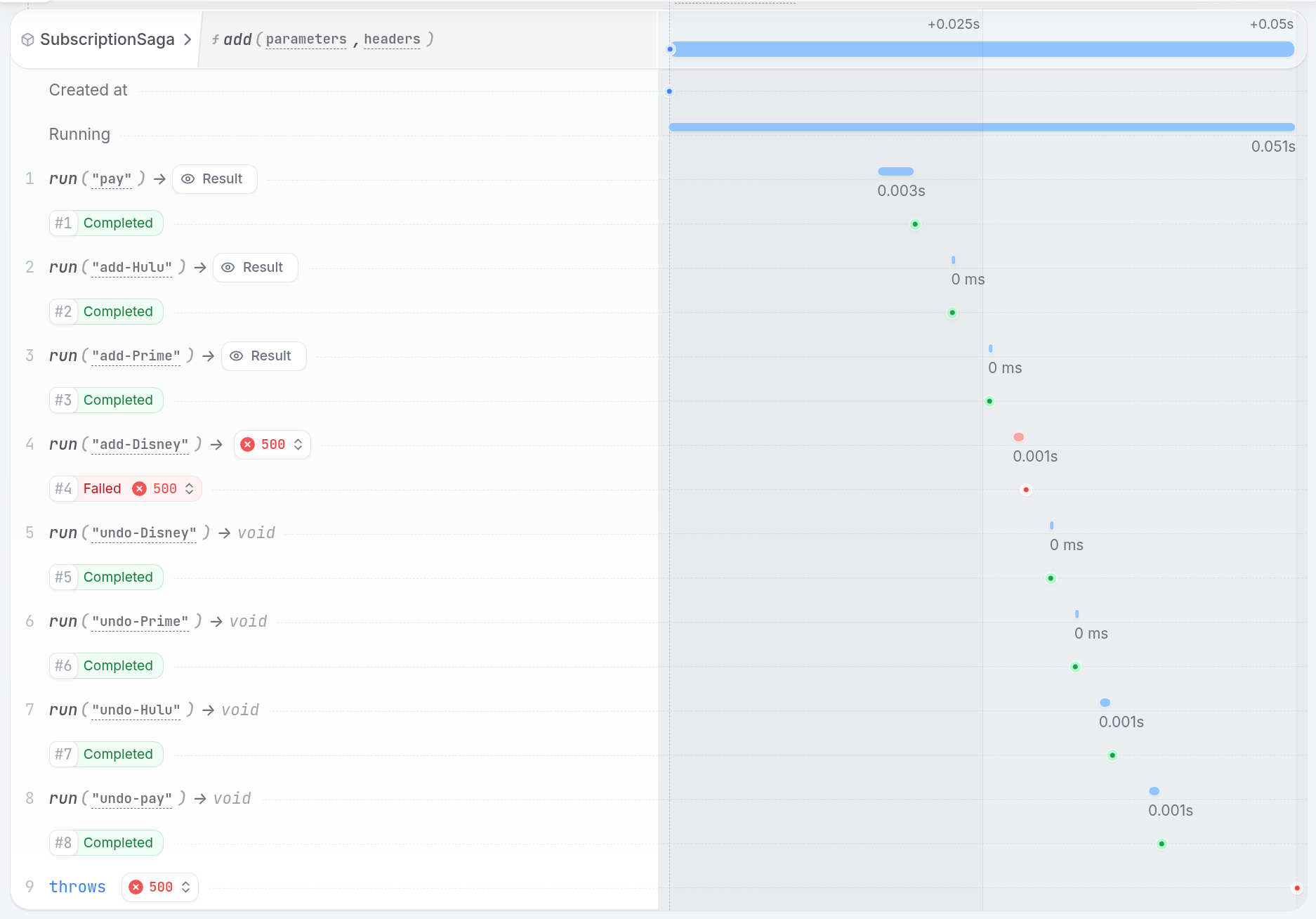
The Disney subscription is not available, so the handler will fail and run compensations:
 Learn more with the [Sagas Guide](/guides/sagas).
## Virtual Objects
Until now, the services we looked at did not share any state between requests.
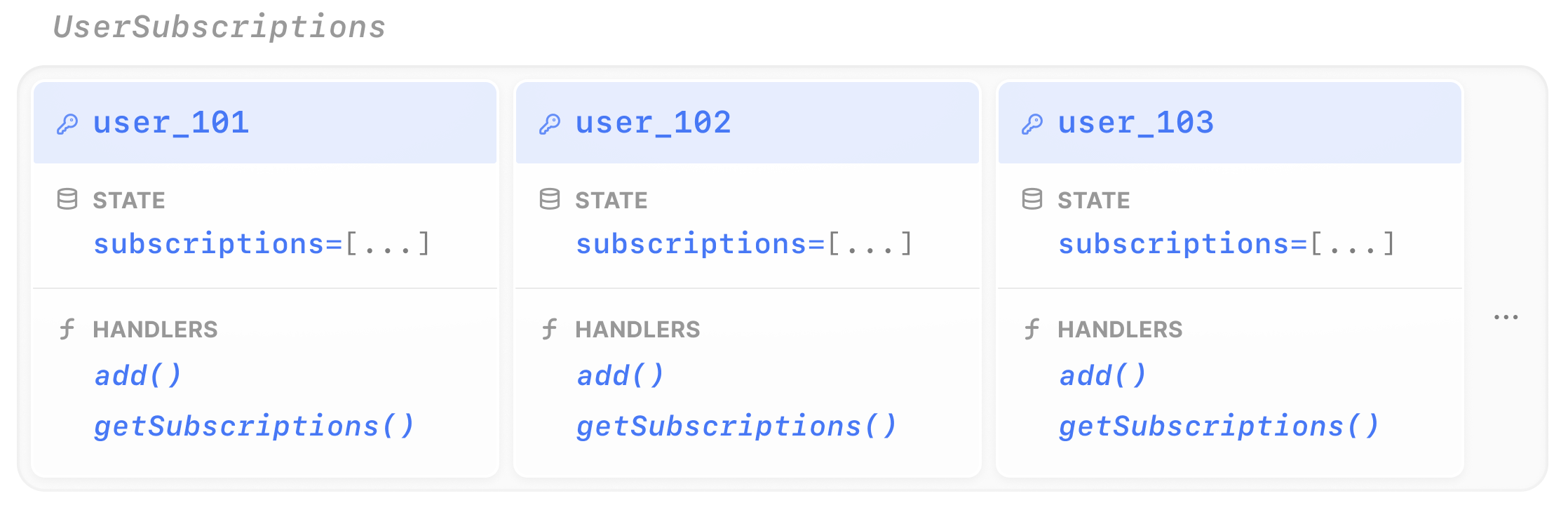
To implement stateful entities like shopping carts, user profiles, or AI agents, Restate provides **Virtual Objects**.
Each Virtual Object instance maintains isolated state and is identified by a unique key.
Here is an example of a Virtual Object that tracks user subscriptions:
Learn more with the [Sagas Guide](/guides/sagas).
## Virtual Objects
Until now, the services we looked at did not share any state between requests.
To implement stateful entities like shopping carts, user profiles, or AI agents, Restate provides **Virtual Objects**.
Each Virtual Object instance maintains isolated state and is identified by a unique key.
Here is an example of a Virtual Object that tracks user subscriptions:
```ts src/objects/service.ts {"CODE_LOAD::https://raw.githubusercontent.com/restatedev/examples/refs/heads/main/typescript/tutorials/tour-of-orchestration-typescript/src/objects/service.ts?collapse_prequel"} theme={null}
export const userSubscriptions = restate.object({
name: "UserSubscriptions",
handlers: {
add: async (ctx: ObjectContext, subscription: string) => {
// Get current subscriptions
const subscriptions = (await ctx.get("subscriptions")) ?? [];
// Add new subscription
if (!subscriptions.includes(subscription)) {
subscriptions.push(subscription);
}
ctx.set("subscriptions", subscriptions);
// Update metrics
ctx.set("lastUpdated", await ctx.date.toJSON());
},
getSubscriptions: restate.handlers.object.shared(
async (ctx: ObjectSharedContext) => {
return (await ctx.get("subscriptions")) ?? [];
},
),
},
});
```
Virtual Objects are ideal for implementing any entity with mutable state:
* **Long-lived state**: K/V state is stored permanently. It has no automatic expiry. Clear it via `ctx.clear()`.
* **Durable state changes**: State changes are logged with Durable Execution, so they survive failures and are consistent with code execution
* **State is queryable** via the state tab in the UI:
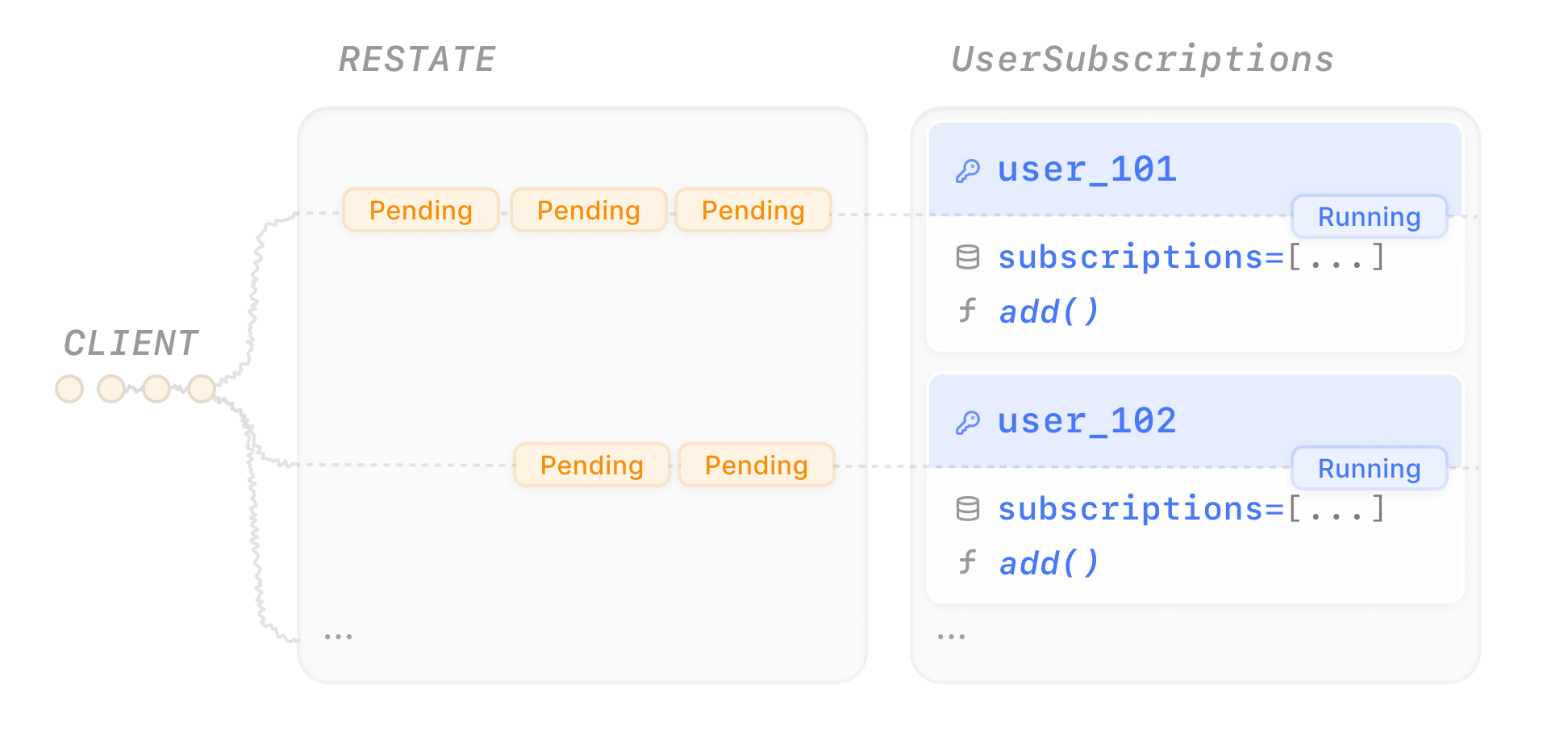
 * **Built-in concurrency control**: Restate’s Virtual Objects have built-in queuing and consistency guarantees per object key. Handlers either have read-write access (`ObjectContext`) or read-only access (shared object context).
* Only one handler with write access can run at a time per object key to prevent concurrent/lost writes or race conditions.
* Handlers with read-only access can run concurrently to the write-access handlers.
* **Built-in concurrency control**: Restate’s Virtual Objects have built-in queuing and consistency guarantees per object key. Handlers either have read-write access (`ObjectContext`) or read-only access (shared object context).
* Only one handler with write access can run at a time per object key to prevent concurrent/lost writes or race conditions.
* Handlers with read-only access can run concurrently to the write-access handlers.
 ```java objects/UserSubscriptions.java {"CODE_LOAD::https://raw.githubusercontent.com/restatedev/examples/refs/heads/main/java/tutorials/tour-of-orchestration-java/src/main/java/my/example/objects/UserSubscriptions.java?collapse_prequel"} theme={null}
@VirtualObject
public class UserSubscriptions {
private static final StateKey> SUBSCRIPTIONS =
StateKey.of("subscriptions", new TypeRef<>() {});
private static final StateKey LAST_UPDATED = StateKey.of("lastUpdated", String.class);
@Handler
public void add(ObjectContext ctx, String subscription) {
// Get current subscriptions
Set subscriptions = ctx.get(SUBSCRIPTIONS).orElse(new HashSet<>());
// Add new subscription
subscriptions.add(subscription);
ctx.set(SUBSCRIPTIONS, subscriptions);
// Update metrics
ctx.set(LAST_UPDATED, Instant.now().toString());
}
@Shared
public Set getSubscriptions(SharedObjectContext ctx) {
return ctx.get(SUBSCRIPTIONS).orElse(Set.of());
}
}
```
Virtual Objects are ideal for implementing any entity with mutable state:
* **Long-lived state**: K/V state is stored permanently. It has no automatic expiry. Clear it via `ctx.clear()`.
* **Durable state changes**: State changes are logged with Durable Execution, so they survive failures and are consistent with code execution
* **State is queryable** via the state tab in the UI:
* **Built-in concurrency control**: Restate’s Virtual Objects have built-in queuing and consistency guarantees per object key. Handlers either have read-write access (`ObjectContext`) or read-only access (shared object context).
* Only one handler with write access can run at a time per object key to prevent concurrent/lost writes or race conditions.
* Handlers with read-only access can run concurrently to the write-access handlers.
```go objects.go {"CODE_LOAD::https://raw.githubusercontent.com/restatedev/examples/refs/heads/main/go/tutorials/tour-of-orchestration-go/examples/objects.go?collapse_prequel"} theme={null}
type UserSubscriptions struct{}
func (UserSubscriptions) Add(ctx restate.ObjectContext, subscription string) error {
// Get current subscriptions
subscriptions, err := restate.Get[[]string](ctx, "subscriptions")
if err != nil {
return err
}
if subscriptions == nil {
subscriptions = []string{}
}
// Add new subscription if not already present
found := false
for _, sub := range subscriptions {
if sub == subscription {
found = true
break
}
}
if !found {
subscriptions = append(subscriptions, subscription)
}
// Save subscriptions
restate.Set(ctx, "subscriptions", subscriptions)
// Update metrics
restate.Set(ctx, "lastUpdated", time.Now().Format(time.RFC3339))
return nil
}
func (UserSubscriptions) GetSubscriptions(ctx restate.ObjectSharedContext) ([]string, error) {
return restate.Get[[]string](ctx, "subscriptions")
}
```
Virtual Objects are ideal for implementing any entity with mutable state:
* **Long-lived state**: K/V state is stored permanently. It has no automatic expiry. Clear it via `restate.Clear(ctx, "my-key")`.
* **Durable state changes**: State changes are logged with Durable Execution, so they survive failures and are consistent with code execution
* **State is queryable** via the state tab in the UI:
* **Built-in concurrency control**: Restate’s Virtual Objects have built-in queuing and consistency guarantees per object key. Handlers either have read-write access (`ObjectContext`) or read-only access (shared object context).
* Only one handler with write access can run at a time per object key to prevent concurrent/lost writes or race conditions.
* Handlers with read-only access can run concurrently to the write-access handlers.
```python app/objects/service.py {"CODE_LOAD::https://raw.githubusercontent.com/restatedev/examples/refs/heads/main/python/tutorials/tour-of-orchestration-python/app/objects/service.py?collapse_prequel"} theme={null}
user_subscriptions = restate.VirtualObject("UserSubscriptions")
@user_subscriptions.handler()
async def add(ctx: restate.ObjectContext, subscription: str) -> None:
# Get current subscriptions
subscriptions = await ctx.get("subscriptions", type_hint=List[str]) or []
# Add new subscription
if subscription not in subscriptions:
subscriptions.append(subscription)
ctx.set("subscriptions", subscriptions)
# Update metrics
ctx.set("lastUpdated", datetime.now().isoformat())
@user_subscriptions.handler("getSubscriptions")
async def get_subscriptions(ctx: restate.ObjectSharedContext) -> List[str]:
return await ctx.get("subscriptions", type_hint=List[str]) or []
```
Virtual Objects are ideal for implementing any entity with mutable state:
* **Long-lived state**: K/V state is stored permanently. It has no automatic expiry. Clear it via `ctx.clear()`.
* **Durable state changes**: State changes are logged with Durable Execution, so they survive failures and are consistent with code execution
* **State is queryable** via the state tab in the UI:
* **Built-in concurrency control**: Restate’s Virtual Objects have built-in queuing and consistency guarantees per object key. Handlers either have read-write access (`ObjectContext`) or read-only access (shared object context).
* Only one handler with write access can run at a time per object key to prevent concurrent/lost writes or race conditions.
* Handlers with read-only access can run concurrently to the write-access handlers.
```java objects/UserSubscriptions.java {"CODE_LOAD::https://raw.githubusercontent.com/restatedev/examples/refs/heads/main/java/tutorials/tour-of-orchestration-java/src/main/java/my/example/objects/UserSubscriptions.java?collapse_prequel"} theme={null}
@VirtualObject
public class UserSubscriptions {
private static final StateKey> SUBSCRIPTIONS =
StateKey.of("subscriptions", new TypeRef<>() {});
private static final StateKey LAST_UPDATED = StateKey.of("lastUpdated", String.class);
@Handler
public void add(ObjectContext ctx, String subscription) {
// Get current subscriptions
Set subscriptions = ctx.get(SUBSCRIPTIONS).orElse(new HashSet<>());
// Add new subscription
subscriptions.add(subscription);
ctx.set(SUBSCRIPTIONS, subscriptions);
// Update metrics
ctx.set(LAST_UPDATED, Instant.now().toString());
}
@Shared
public Set getSubscriptions(SharedObjectContext ctx) {
return ctx.get(SUBSCRIPTIONS).orElse(Set.of());
}
}
```
Virtual Objects are ideal for implementing any entity with mutable state:
* **Long-lived state**: K/V state is stored permanently. It has no automatic expiry. Clear it via `ctx.clear()`.
* **Durable state changes**: State changes are logged with Durable Execution, so they survive failures and are consistent with code execution
* **State is queryable** via the state tab in the UI:
* **Built-in concurrency control**: Restate’s Virtual Objects have built-in queuing and consistency guarantees per object key. Handlers either have read-write access (`ObjectContext`) or read-only access (shared object context).
* Only one handler with write access can run at a time per object key to prevent concurrent/lost writes or race conditions.
* Handlers with read-only access can run concurrently to the write-access handlers.
```go objects.go {"CODE_LOAD::https://raw.githubusercontent.com/restatedev/examples/refs/heads/main/go/tutorials/tour-of-orchestration-go/examples/objects.go?collapse_prequel"} theme={null}
type UserSubscriptions struct{}
func (UserSubscriptions) Add(ctx restate.ObjectContext, subscription string) error {
// Get current subscriptions
subscriptions, err := restate.Get[[]string](ctx, "subscriptions")
if err != nil {
return err
}
if subscriptions == nil {
subscriptions = []string{}
}
// Add new subscription if not already present
found := false
for _, sub := range subscriptions {
if sub == subscription {
found = true
break
}
}
if !found {
subscriptions = append(subscriptions, subscription)
}
// Save subscriptions
restate.Set(ctx, "subscriptions", subscriptions)
// Update metrics
restate.Set(ctx, "lastUpdated", time.Now().Format(time.RFC3339))
return nil
}
func (UserSubscriptions) GetSubscriptions(ctx restate.ObjectSharedContext) ([]string, error) {
return restate.Get[[]string](ctx, "subscriptions")
}
```
Virtual Objects are ideal for implementing any entity with mutable state:
* **Long-lived state**: K/V state is stored permanently. It has no automatic expiry. Clear it via `restate.Clear(ctx, "my-key")`.
* **Durable state changes**: State changes are logged with Durable Execution, so they survive failures and are consistent with code execution
* **State is queryable** via the state tab in the UI:
* **Built-in concurrency control**: Restate’s Virtual Objects have built-in queuing and consistency guarantees per object key. Handlers either have read-write access (`ObjectContext`) or read-only access (shared object context).
* Only one handler with write access can run at a time per object key to prevent concurrent/lost writes or race conditions.
* Handlers with read-only access can run concurrently to the write-access handlers.
```python app/objects/service.py {"CODE_LOAD::https://raw.githubusercontent.com/restatedev/examples/refs/heads/main/python/tutorials/tour-of-orchestration-python/app/objects/service.py?collapse_prequel"} theme={null}
user_subscriptions = restate.VirtualObject("UserSubscriptions")
@user_subscriptions.handler()
async def add(ctx: restate.ObjectContext, subscription: str) -> None:
# Get current subscriptions
subscriptions = await ctx.get("subscriptions", type_hint=List[str]) or []
# Add new subscription
if subscription not in subscriptions:
subscriptions.append(subscription)
ctx.set("subscriptions", subscriptions)
# Update metrics
ctx.set("lastUpdated", datetime.now().isoformat())
@user_subscriptions.handler("getSubscriptions")
async def get_subscriptions(ctx: restate.ObjectSharedContext) -> List[str]:
return await ctx.get("subscriptions", type_hint=List[str]) or []
```
Virtual Objects are ideal for implementing any entity with mutable state:
* **Long-lived state**: K/V state is stored permanently. It has no automatic expiry. Clear it via `ctx.clear()`.
* **Durable state changes**: State changes are logged with Durable Execution, so they survive failures and are consistent with code execution
* **State is queryable** via the state tab in the UI:
* **Built-in concurrency control**: Restate’s Virtual Objects have built-in queuing and consistency guarantees per object key. Handlers either have read-write access (`ObjectContext`) or read-only access (shared object context).
* Only one handler with write access can run at a time per object key to prevent concurrent/lost writes or race conditions.
* Handlers with read-only access can run concurrently to the write-access handlers.
Add a few subscriptions for some users.
To call a Virtual Object, you specify the object key in the URL (here `user-123` and `user-456`):
```bash theme={null}
curl localhost:8080/restate/call/UserSubscriptions/user-123/add --json '"Hulu"'
curl localhost:8080/restate/call/UserSubscriptions/user-123/add --json '"Prime"'
curl localhost:8080/restate/call/UserSubscriptions/user-123/add --json '"Disney"'
curl localhost:8080/restate/call/UserSubscriptions/user-456/add --json '"Netflix"'
```
Get the subscriptions for `user-123`:
```bash theme={null}
curl localhost:8080/restate/call/UserSubscriptions/user-123/getSubscriptions
```
```bash theme={null}
curl localhost:8080/restate/call/UserSubscriptions/user-123/add --json '"Hulu"'
curl localhost:8080/restate/call/UserSubscriptions/user-123/add --json '"Prime"'
curl localhost:8080/restate/call/UserSubscriptions/user-123/add --json '"Disney"'
curl localhost:8080/restate/call/UserSubscriptions/user-456/add --json '"Netflix"'
```
Get the subscriptions for `user-123`:
```bash theme={null}
curl localhost:8080/restate/call/UserSubscriptions/user-123/getSubscriptions
```
```bash theme={null}
curl localhost:8080/restate/call/UserSubscriptions/user-123/Add --json '"Hulu"'
curl localhost:8080/restate/call/UserSubscriptions/user-123/Add --json '"Prime"'
curl localhost:8080/restate/call/UserSubscriptions/user-123/Add --json '"Disney"'
curl localhost:8080/restate/call/UserSubscriptions/user-456/Add --json '"Netflix"'
```
Get the subscriptions for `user-123`:
```bash theme={null}
curl localhost:8080/restate/call/UserSubscriptions/user-123/GetSubscriptions
```
```bash theme={null}
curl localhost:8080/restate/call/UserSubscriptions/user-123/add --json '"Hulu"'
curl localhost:8080/restate/call/UserSubscriptions/user-123/add --json '"Prime"'
curl localhost:8080/restate/call/UserSubscriptions/user-123/add --json '"Disney"'
curl localhost:8080/restate/call/UserSubscriptions/user-456/add --json '"Netflix"'
```
Get the subscriptions for `user-123`:
```bash theme={null}
curl localhost:8080/restate/call/UserSubscriptions/user-123/getSubscriptions
```
Or use the UI's state tab to explore the object state.
## Resilient Communication
The Restate SDK includes clients to call other handlers reliably. You can call another handler in three ways:
* **Request-Response**: Wait for a response
* **One-Way Messages**: Fire-and-forget
* **Delayed Messages**: Schedule for later
When you call another handler, the Restate Server acts as a message broker.
All communication is proxied via the Restate Server where it gets durably logged and retried till completion.
Imagine a handler which processes a concert ticket purchase, and calls multiple services to handle payment, ticket delivery, and reminders:
```ts src/communication/service.ts {"CODE_LOAD::https://raw.githubusercontent.com/restatedev/examples/refs/heads/main/typescript/tutorials/tour-of-orchestration-typescript/src/communication/service.ts?collapse_prequel"} theme={null}
export const concertTicketingService = restate.service({
name: "ConcertTicketingService",
handlers: {
buy: async (ctx: Context, req: PurchaseTicketRequest) => {
// Request-response call - wait for payment to complete
const payRef = await ctx.serviceClient(paymentService).charge(req);
// One-way message - fire and forget ticket delivery
ctx.serviceSendClient(emailService).emailTicket(req);
// Delayed message - schedule reminder for day before concert
ctx
.serviceSendClient(emailService)
.sendReminder(req, sendOpts({ delay: dayBefore(req.concertDate) }));
return `Ticket purchased successfully with payment reference: ${payRef}`;
},
},
});
```
```java communication/ConcertTicketingService.java {"CODE_LOAD::https://raw.githubusercontent.com/restatedev/examples/refs/heads/main/java/tutorials/tour-of-orchestration-java/src/main/java/my/example/communication/ConcertTicketingService.java?collapse_prequel"} theme={null}
@Service
public class ConcertTicketingService {
@Handler
public String buy(Context ctx, PurchaseTicketRequest req) {
// Request-response call - wait for payment to complete
String payRef = PaymentServiceClient.fromContext(ctx).charge(req).await();
// One-way message - fire and forget ticket delivery
EmailServiceClient.fromContext(ctx).send().emailTicket(req);
// Delayed message - schedule reminder for day before concert
EmailServiceClient.fromContext(ctx).send().sendReminder(req, req.dayBefore());
return "Ticket purchased successfully with payment reference: " + payRef;
}
}
```
```go communication.go {"CODE_LOAD::https://raw.githubusercontent.com/restatedev/examples/refs/heads/main/go/tutorials/tour-of-orchestration-go/examples/communication.go?collapse_prequel"} theme={null}
type ConcertTicketingService struct{}
func (ConcertTicketingService) Buy(ctx restate.Context, req PurchaseTicketRequest) (string, error) {
// Request-response call - wait for payment to complete
payRef, err := restate.Service[string](ctx, "PaymentService", "Charge").Request(req)
if err != nil {
return "", err
}
// One-way message - fire and forget ticket delivery
restate.Service[restate.Void](ctx, "EmailService", "EmailTicket").Send(req)
// Delayed message - schedule reminder for day before concert
delay := DayBefore(req.ConcertDate)
restate.Service[restate.Void](ctx, "EmailService", "SendReminder").
Send(req, restate.WithDelay(delay))
return fmt.Sprintf("Ticket purchased successfully with payment reference: %s", payRef), nil
}
```
```python app/communication/service.py {"CODE_LOAD::https://raw.githubusercontent.com/restatedev/examples/refs/heads/main/python/tutorials/tour-of-orchestration-python/app/communication/service.py?collapse_prequel"} theme={null}
concert_ticketing_service = restate.Service("ConcertTicketingService")
@concert_ticketing_service.handler()
async def buy(ctx: restate.Context, req: PurchaseTicketRequest) -> str:
# Request-response call - wait for payment to complete
pay_ref = await ctx.service_call(charge, req)
# One-way message - fire and forget ticket delivery
ctx.service_send(email_ticket, req)
# Delayed message - schedule reminder for day before concert
ctx.service_send(send_reminder_email, req, send_delay=day_before(req.concert_date))
return f"Ticket purchased successfully with payment reference: {pay_ref}"
```
Each of these calls gets persisted in Restate's log and will be retried upon failures.
The handler can finish execution without waiting for the ticket delivery or reminder to complete.
You can use Restate's communication primitives to implement microservices that communicate reliably and scale independently.
Buy a concert ticket:
```bash theme={null}
curl localhost:8080/restate/call/ConcertTicketingService/buy --json '{
"ticketId": "ticket-789",
"price": 100,
"customerEmail": "me@mail.com",
"concertDate": "2026-10-01T20:00:00Z"
}'
```
```bash theme={null}
curl localhost:8080/restate/call/ConcertTicketingService/buy --json '{
"ticketId": "ticket-789",
"price": 100,
"customerEmail": "me@mail.com",
"concertDate": "2026-10-01T20:00:00Z"
}'
```
```bash theme={null}
curl localhost:8080/restate/call/ConcertTicketingService/Buy --json '{
"ticketId": "ticket-789",
"price": 100,
"customerEmail": "me@mail.com",
"concertDate": "2026-10-01T20:00:00Z"
}'
```
```bash theme={null}
curl localhost:8080/restate/call/ConcertTicketingService/buy --json '{
"ticketId": "ticket-789",
"price": 100,
"customerEmail": "me@mail.com",
"concertDate": "2026-10-01T20:00:00Z"
}'
```
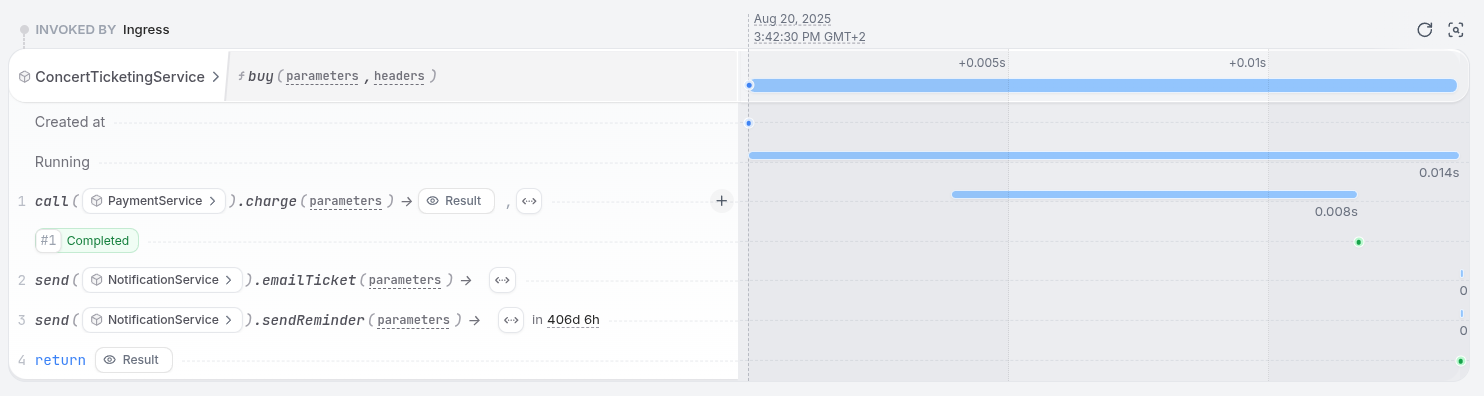
See in the UI how the first call had the response logged, while the ticket delivery happened asynchronously and the reminder was scheduled for in 406 days:
 ## Request Idempotency
Restate allows adding an idempotency header to your requests. It will then deduplicate requests with the same idempotency key, ensuring that they only execute once.
This can help us prevent duplicate calls the concert ticketing service if the user accidentally clicks "buy" multiple times.
Add an idempotency header to your request:
## Request Idempotency
Restate allows adding an idempotency header to your requests. It will then deduplicate requests with the same idempotency key, ensuring that they only execute once.
This can help us prevent duplicate calls the concert ticketing service if the user accidentally clicks "buy" multiple times.
Add an idempotency header to your request:
```shell theme={null}
curl -X POST localhost:8080/restate/call/ConcertTicketingService/buy \
-H 'Idempotency-Key: unique-key-123' \
--json '{"ticketId": "ticket-789", "price": 100, "customerEmail": "me@mail.com", "concertDate": "2023-10-01T20:00:00Z"}'
```
```shell theme={null}
curl -X POST localhost:8080/restate/call/ConcertTicketingService/buy \
-H 'Idempotency-Key: unique-key-123' \
--json '{"ticketId": "ticket-789", "price": 100, "customerEmail": "me@mail.com", "concertDate": "2023-10-01T20:00:00Z"}'
```
```shell theme={null}
curl -X POST localhost:8080/restate/call/ConcertTicketingService/Buy \
-H 'Idempotency-Key: unique-key-123' \
--json '{"ticketId": "ticket-789", "price": 100, "customerEmail": "me@mail.com", "concertDate": "2023-10-01T20:00:00Z"}'
```
```shell theme={null}
curl -X POST localhost:8080/restate/call/ConcertTicketingService/buy \
-H 'Idempotency-Key: unique-key-123' \
--json '{"ticketId": "ticket-789", "price": 100, "customerEmail": "me@mail.com", "concertDate": "2023-10-01T20:00:00Z"}'
```
Notice how doing the same request with the same idempotency key will print the same payment reference.
Instead of executing the handler again, Restate returns the result of the first execution.
## External Events
Until now we showed either synchronous API calls via `run` or calls to other Restate services.
Another common scenario is APIs that respond asynchronously via webhooks or callbacks.
For this, you can use Restate's awakeables.
For example, some payment providers like Stripe require you to initiate a payment and then wait for their webhook to confirm the transaction.
```ts src/events/service.ts {"CODE_LOAD::https://raw.githubusercontent.com/restatedev/examples/refs/heads/main/typescript/tutorials/tour-of-orchestration-typescript/src/events/service.ts?collapse_prequel"} theme={null}
export const payments = restate.service({
name: "Payments",
handlers: {
process: async (ctx: Context, req: PaymentRequest) => {
// Create awakeable to wait for webhook payment confirmation
const confirmation = ctx.awakeable();
// Initiate payment with external provider (Stripe, PayPal, etc.)
const paymentId = ctx.rand.uuidv4();
await ctx.run("pay", () => initPayment(req, paymentId, confirmation.id));
// Wait for external payment provider to call our webhook
return confirmation.promise;
},
// Webhook handler called by external payment provider
confirm: async (
ctx: Context,
confirmation: { id: string; result: PaymentResult },
) => {
// Resolve the awakeable to continue the payment flow
ctx.resolveAwakeable(confirmation.id, confirmation.result);
},
},
});
```
```java events/Payments.java {"CODE_LOAD::https://raw.githubusercontent.com/restatedev/examples/refs/heads/main/java/tutorials/tour-of-orchestration-java/src/main/java/my/example/events/Payments.java?collapse_prequel"} theme={null}
@Service
public class Payments {
@Handler
public PaymentResult process(Context ctx, PaymentRequest req) {
// Create awakeable to wait for webhook payment confirmation
var confirmation = ctx.awakeable(PaymentResult.class);
// Initiate payment with external provider (Stripe, PayPal, etc.)
var paymentId = ctx.random().nextUUID().toString();
ctx.run(() -> initPayment(req, paymentId, confirmation.id()));
// Wait for external payment provider to call our webhook
return confirmation.await();
}
// Webhook handler called by external payment provider
@Handler
public void confirm(Context ctx, ConfirmationRequest confirmation) {
// Resolve the awakeable to continue the payment flow
ctx.awakeableHandle(confirmation.id()).resolve(PaymentResult.class, confirmation.result());
}
}
```
```go events.go {"CODE_LOAD::https://raw.githubusercontent.com/restatedev/examples/refs/heads/main/go/tutorials/tour-of-orchestration-go/examples/events.go?collapse_prequel"} theme={null}
type Payments struct{}
func (Payments) Process(ctx restate.Context, req PaymentRequest) (PaymentResult, error) {
// Create awakeable to wait for webhook payment confirmation
confirmation := restate.Awakeable[PaymentResult](ctx)
// Initiate payment with external provider (Stripe, PayPal, etc.)
paymentId := restate.UUID(ctx).String()
_, err := restate.Run(ctx, func(ctx restate.RunContext) (string, error) {
return InitPayment(req, paymentId, confirmation.Id())
}, restate.WithName("pay"))
if err != nil {
return PaymentResult{}, err
}
// Wait for external payment provider to call our webhook
return confirmation.Result()
}
// Webhook handler called by external payment provider
func (Payments) Confirm(ctx restate.Context, confirmation ConfirmationRequest) error {
// Resolve the awakeable to continue the payment flow
restate.ResolveAwakeable(ctx, confirmation.Id, confirmation.Result)
return nil
}
```
```python app/events/service.py {"CODE_LOAD::https://raw.githubusercontent.com/restatedev/examples/refs/heads/main/python/tutorials/tour-of-orchestration-python/app/events/service.py?collapse_prequel"} theme={null}
payments = restate.Service("Payments")
@payments.handler()
async def process(ctx: restate.Context, req: PaymentRequest) -> PaymentResult:
# Create awakeable to wait for webhook payment confirmation
confirmation_id, confirmation_promise = ctx.awakeable(type_hint=PaymentResult)
# Initiate payment with external provider (Stripe, PayPal, etc.)
payment_id = str(ctx.uuid())
await ctx.run_typed(
"pay",
init_payment,
req=req,
payment_id=payment_id,
confirmation_id=confirmation_id,
)
# Wait for external payment provider to call our webhook
return await confirmation_promise
@payments.handler()
async def confirm(ctx: restate.Context, confirmation: ConfirmationRequest) -> None:
# Resolve the awakeable to continue the payment flow
ctx.resolve_awakeable(confirmation.id, confirmation.result)
```
Awakeables are like promises or futures that can be recovered after a crash.
Restate persists the awakeable in its log and can recover it on another process when needed.
There is no limit to how long you can persist an awakeable, so you can wait for external events that may take hours, or even months to arrive.
You can also use awakeables to implement human-in-the-loop interactions, such as waiting for user input or approvals.
Initiate a payment by calling the `process` handler. Use the `send` verb to call the handler without waiting for the response:
```bash theme={null}
curl localhost:8080/restate/send/Payments/process \
--json '{"amount": 100, "currency": "USD", "customerId": "cust-123", "orderId": "order-456"}'
```
```bash theme={null}
curl localhost:8080/restate/send/Payments/process \
--json '{"amount": 100, "currency": "USD", "customerId": "cust-123", "orderId": "order-456"}'
```
```bash theme={null}
curl localhost:8080/restate/send/Payments/Process \
--json '{"amount": 100, "currency": "USD", "customerId": "cust-123", "orderId": "order-456"}'
```
```bash theme={null}
curl localhost:8080/restate/send/Payments/process \
--json '{"amount": 100, "currency": "USD", "customerId": "cust-123", "orderId": "order-456"}'
```
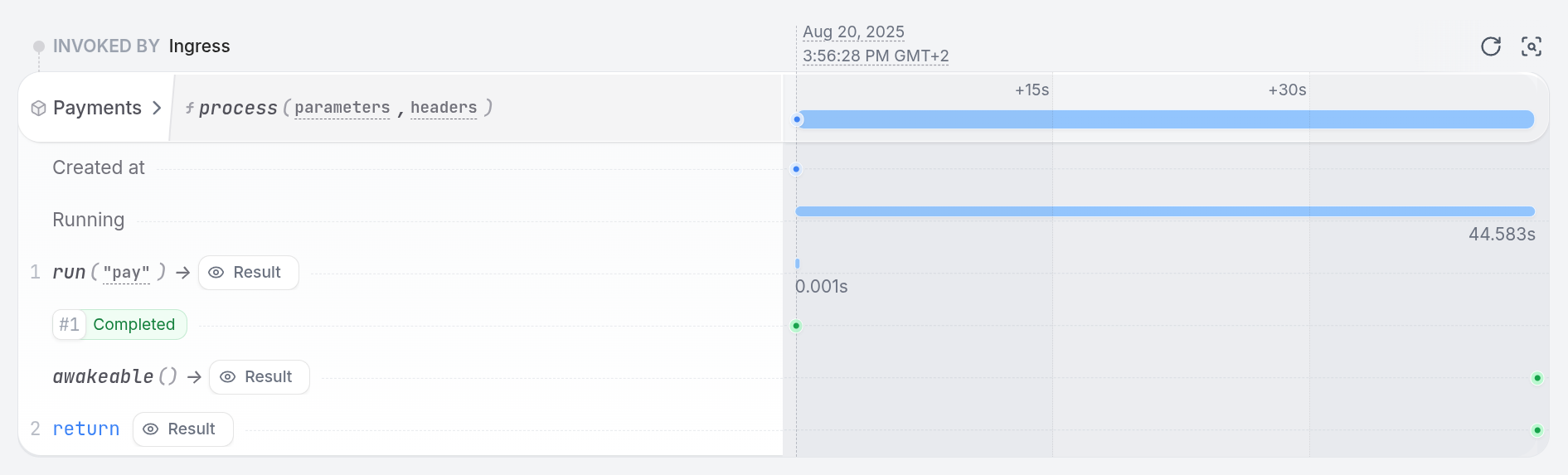
In the UI, you can see that the payment is waiting for confirmation.
You can restart the service to see how Restate continues waiting for the payment confirmation.
Simulate approving the payment by executing the **curl request that was printed in the service logs**, similar to:
```bash theme={null}
curl localhost:8080/restate/call/Payments/confirm \
--json '{"id": "sign_1PrDkbECjgdsBmMfEUQyCnioCP-csLbd2AAAAEQ", "result": {"success": true, "transactionId": "txn-123"}}'
```
```bash theme={null}
curl localhost:8080/restate/call/Payments/confirm \
--json '{"id": "sign_1PrDkbECjgdsBmMfEUQyCnioCP-csLbd2AAAAEQ", "result": {"success": true, "transactionId": "txn-123"}}'
```
```bash theme={null}
curl localhost:8080/restate/call/Payments/Confirm \
--json '{"id": "sign_1PrDkbECjgdsBmMfEUQyCnioCP-csLbd2AAAAEQ", "result": {"success": true, "transactionId": "txn-123"}}'
```
```bash theme={null}
curl localhost:8080/restate/call/Payments/confirm \
--json '{"id": "sign_1PrDkbECjgdsBmMfEUQyCnioCP-csLbd2AAAAEQ", "result": {"success": true, "transactionId": "txn-123"}}'
```
You can see in the UI that the payment was processed successfully and the awakeable was resolved:
 ## Durable Timers
Waiting on external events might take a long time, and you might want to add timeouts to operations like this.
The Restate SDK offers durable timer implementations that you can use to limit waiting for an action.
Restate tracks these timers so they survive crashes and do not restart from the beginning.
Let's extend our payment service to automatically cancel payments that don't complete within a reasonable time:
## Durable Timers
Waiting on external events might take a long time, and you might want to add timeouts to operations like this.
The Restate SDK offers durable timer implementations that you can use to limit waiting for an action.
Restate tracks these timers so they survive crashes and do not restart from the beginning.
Let's extend our payment service to automatically cancel payments that don't complete within a reasonable time:
```ts src/timers/service.ts {"CODE_LOAD::https://raw.githubusercontent.com/restatedev/examples/refs/heads/main/typescript/tutorials/tour-of-orchestration-typescript/src/timers/service.ts?collapse_prequel"} theme={null}
export const paymentsWithTimeout = restate.service({
name: "PaymentsWithTimeout",
handlers: {
process: async (ctx: Context, req: PaymentRequest) => {
const confirmation = ctx.awakeable();
const paymentId = ctx.rand.uuidv4();
const payRef = await ctx.run("pay", () =>
initPayment(req, paymentId, confirmation.id),
);
// Race between payment confirmation and timeout
try {
return await confirmation.promise.orTimeout({ seconds: 30 });
} catch (e) {
if (e instanceof TimeoutError) {
// Cancel the payment with external provider
await ctx.run("cancel-payment", () => cancelPayment(payRef));
return {
success: false,
errorMessage: "Payment timeout",
};
}
throw e;
}
},
confirm: async (
ctx: Context,
confirmation: { id: string; result: PaymentResult },
) => {
ctx.resolveAwakeable(confirmation.id, confirmation.result);
},
},
});
```
```java timers/PaymentsWithTimeout.java {"CODE_LOAD::https://raw.githubusercontent.com/restatedev/examples/refs/heads/main/java/tutorials/tour-of-orchestration-java/src/main/java/my/example/timers/PaymentsWithTimeout.java?collapse_prequel"} theme={null}
@Service
public class PaymentsWithTimeout {
@Handler
public PaymentResult process(Context ctx, PaymentRequest req) {
var confirmation = ctx.awakeable(PaymentResult.class);
var paymentId = ctx.random().nextUUID().toString();
String payRef =
ctx.run("pay", String.class, () -> initPayment(req, paymentId, confirmation.id()));
try {
return confirmation.await(Duration.ofSeconds(30));
} catch (TimeoutException e) {
ctx.run("cancel-payment", () -> cancelPayment(payRef));
return new PaymentResult(false, null, "Payment timeout");
}
}
@Handler
public void confirm(Context ctx, ConfirmationRequest confirmation) {
ctx.awakeableHandle(confirmation.id()).resolve(PaymentResult.class, confirmation.result());
}
}
```
```go timers.go {"CODE_LOAD::https://raw.githubusercontent.com/restatedev/examples/refs/heads/main/go/tutorials/tour-of-orchestration-go/examples/timers.go?collapse_prequel"} theme={null}
type PaymentsWithTimeout struct{}
func (PaymentsWithTimeout) Process(ctx restate.Context, req PaymentRequest) (PaymentResult, error) {
confirmation := restate.Awakeable[PaymentResult](ctx)
paymentId := restate.UUID(ctx).String()
payRef, err := restate.Run(ctx, func(ctx restate.RunContext) (string, error) {
return InitPayment(req, paymentId, confirmation.Id())
}, restate.WithName("pay"))
if err != nil {
return PaymentResult{}, err
}
// Race between payment confirmation and timeout
timeout := restate.After(ctx, 30*time.Second)
resFut, err := restate.WaitFirst(ctx, confirmation, timeout)
if err != nil {
return PaymentResult{}, err
}
switch resFut {
case confirmation:
return confirmation.Result()
default:
if err := timeout.Done(); err != nil {
return PaymentResult{}, err
}
// Cancel the payment with external provider
_, err := restate.Run(ctx, func(ctx restate.RunContext) (restate.Void, error) {
return CancelPayment(payRef)
}, restate.WithName("cancel-payment"))
if err != nil {
return PaymentResult{}, err
}
return PaymentResult{
Success: false,
ErrorMessage: "Payment timeout",
}, nil
}
}
func (PaymentsWithTimeout) Confirm(ctx restate.Context, confirmation ConfirmationRequest) error {
restate.ResolveAwakeable(ctx, confirmation.Id, confirmation.Result)
return nil
}
```
```python app/timers/service.py {"CODE_LOAD::https://raw.githubusercontent.com/restatedev/examples/refs/heads/main/python/tutorials/tour-of-orchestration-python/app/timers/service.py?collapse_prequel"} theme={null}
payments_with_timeout = restate.Service("PaymentsWithTimeout")
@payments_with_timeout.handler()
async def process(ctx: restate.Context, req: PaymentRequest) -> PaymentResult:
confirmation_id, confirmation_promise = ctx.awakeable(type_hint=PaymentResult)
payment_id = str(ctx.uuid())
pay_ref = await ctx.run_typed(
"pay",
init_payment,
req=req,
payment_id=payment_id,
confirmation_id=confirmation_id,
)
# Race between payment confirmation and timeout
match await restate.select(
confirmation=confirmation_promise, timeout=ctx.sleep(timedelta(seconds=30))
):
case ["confirmation", result]:
return result
case _:
# Cancel the payment with external provider
await ctx.run_typed("cancel-payment", cancel_payment, pay_ref=pay_ref)
return PaymentResult(
success=False, transaction_id=None, error_message="Payment timeout"
)
@payments_with_timeout.handler()
async def confirm(ctx: restate.Context, confirmation: ConfirmationRequest) -> None:
ctx.resolve_awakeable(confirmation.id, confirmation.result)
```
You can also set timeouts for RPC calls or other asynchronous operations with the Restate SDK.
Initiate a payment by calling the `process` handler. Use the `send` verb to call the handler without waiting for the response:
```bash theme={null}
curl localhost:8080/restate/send/PaymentsWithTimeout/process \
--json '{"amount": 100, "currency": "USD", "customerId": "cust-123", "orderId": "order-456"}'
```
```bash theme={null}
curl localhost:8080/restate/send/PaymentsWithTimeout/process \
--json '{"amount": 100, "currency": "USD", "customerId": "cust-123", "orderId": "order-456"}'
```
```bash theme={null}
curl localhost:8080/restate/send/PaymentsWithTimeout/Process \
--json '{"amount": 100, "currency": "USD", "customerId": "cust-123", "orderId": "order-456"}'
```
```bash theme={null}
curl localhost:8080/restate/send/PaymentsWithTimeout/process \
--json '{"amount": 100, "currency": "USD", "customerId": "cust-123", "orderId": "order-456"}'
```
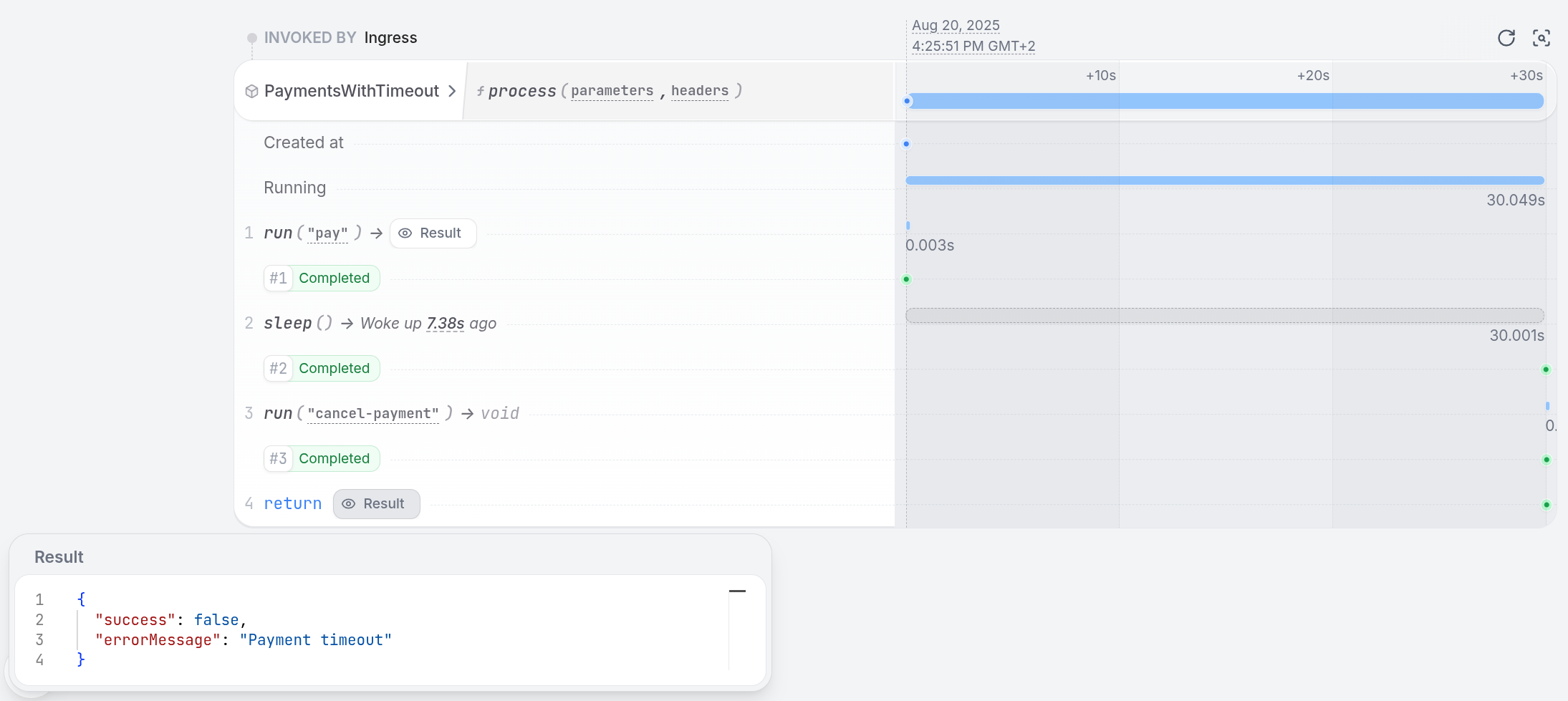
Wait for 30 seconds without confirming the payment.
Try restarting the service while the payment is waiting for confirmation to see how Restate continues waiting for the timer and the confirmation.
In the UI, you can see that the payment times out and cancels the payment:
 ## Concurrent Tasks
When you are waiting on an awakeable or a timer, you are effectively running concurrent tasks and waiting for one of them to complete.
Restate allows more advanced concurrency patterns to run tasks in parallel and wait for their results.
Let's extend our subscription service to process all subscriptions concurrently and handle failures gracefully:
## Concurrent Tasks
When you are waiting on an awakeable or a timer, you are effectively running concurrent tasks and waiting for one of them to complete.
Restate allows more advanced concurrency patterns to run tasks in parallel and wait for their results.
Let's extend our subscription service to process all subscriptions concurrently and handle failures gracefully:
```ts src/concurrenttasks/service.ts {"CODE_LOAD::https://raw.githubusercontent.com/restatedev/examples/refs/heads/main/typescript/tutorials/tour-of-orchestration-typescript/src/concurrenttasks/service.ts?collapse_prequel"} theme={null}
export const parallelSubscriptionService = restate.service({
name: "ParallelSubscriptionService",
handlers: {
add: async (ctx: Context, req: SubscriptionRequest) => {
const paymentId = ctx.rand.uuidv4();
const payRef = await ctx.run("pay", () =>
createRecurringPayment(req.creditCard, paymentId),
);
// Start all subscriptions in parallel
const subscriptionPromises = [];
for (const subscription of req.subscriptions) {
subscriptionPromises.push(
ctx.run(`add-${subscription}`, () =>
createSubscription(req.userId, subscription, payRef),
),
);
}
// Wait for all subscriptions to complete
await RestatePromise.all(subscriptionPromises);
return { success: true, paymentRef: payRef };
},
},
});
```
```java concurrenttasks/ParallelSubscriptionService.java {"CODE_LOAD::https://raw.githubusercontent.com/restatedev/examples/refs/heads/main/java/tutorials/tour-of-orchestration-java/src/main/java/my/example/concurrenttasks/ParallelSubscriptionService.java?collapse_prequel"} theme={null}
@Service
public class ParallelSubscriptionService {
@Handler
public SubscriptionResult add(Context ctx, SubscriptionRequest req) {
var paymentId = ctx.random().nextUUID().toString();
var payRef =
ctx.run("pay", String.class, () -> createRecurringPayment(req.creditCard(), paymentId));
// Start all subscriptions in parallel
List> subscriptionFutures = new ArrayList<>();
for (String subscription : req.subscriptions()) {
subscriptionFutures.add(
ctx.runAsync(
"add-" + subscription, () -> createSubscription(req.userId(), subscription, payRef)));
}
// Wait for all subscriptions to complete
DurableFuture.all(subscriptionFutures).await();
return new SubscriptionResult(true, payRef);
}
}
```
```go concurrenttasks.go {"CODE_LOAD::https://raw.githubusercontent.com/restatedev/examples/refs/heads/main/go/tutorials/tour-of-orchestration-go/examples/concurrenttasks.go?collapse_prequel"} theme={null}
type ParallelSubscriptionService struct{}
func (ParallelSubscriptionService) Add(ctx restate.Context, req SubscriptionRequest) (SubscriptionResult, error) {
paymentId := restate.UUID(ctx).String()
payRef, err := restate.Run(ctx, func(ctx restate.RunContext) (string, error) {
return CreateRecurringPayment(req.CreditCard, paymentId)
}, restate.WithName("pay"))
if err != nil {
return SubscriptionResult{}, err
}
// Process all subscriptions sequentially
var subscriptionFutures []restate.Future
for _, subscription := range req.Subscriptions {
future := restate.RunAsync(ctx, func(ctx restate.RunContext) (string, error) {
return CreateSubscription(req.UserId, subscription, payRef)
}, restate.WithName(fmt.Sprintf("add-%s", subscription)))
subscriptionFutures = append(subscriptionFutures, future)
}
for fut, err := range restate.Wait(ctx, subscriptionFutures...) {
if err != nil {
return SubscriptionResult{}, err
}
_, err := fut.(restate.RunAsyncFuture[string]).Result()
if err != nil {
return SubscriptionResult{}, err
}
}
return SubscriptionResult{
Success: true,
PaymentRef: payRef,
}, nil
}
```
```python app/concurrenttasks/service.py {"CODE_LOAD::https://raw.githubusercontent.com/restatedev/examples/refs/heads/main/python/tutorials/tour-of-orchestration-python/app/concurrenttasks/service.py?collapse_prequel"} theme={null}
parallel_subscription_service = restate.Service("ParallelSubscriptionService")
@parallel_subscription_service.handler()
async def add(ctx: restate.Context, req: SubscriptionRequest) -> SubscriptionResult:
payment_id = str(ctx.uuid())
pay_ref = await ctx.run_typed(
"pay",
create_recurring_payment,
credit_card=req.credit_card,
payment_id=payment_id,
)
# Start all subscriptions in parallel
subscription_tasks = []
for subscription in req.subscriptions:
task = ctx.run_typed(
f"add-{subscription}",
create_subscription,
user_id=req.user_id,
subscription=subscription,
payment_ref=pay_ref,
)
subscription_tasks.append(task)
# Wait for all subscriptions to complete
await restate.gather(*subscription_tasks)
return SubscriptionResult(success=True, payment_ref=pay_ref)
```
Restate retries all parallel tasks until they all complete and can deterministically replay the order of completion.
Add a few subscriptions for some users.
```bash theme={null}
curl localhost:8080/restate/call/ParallelSubscriptionService/add \
--json '{"userId": "user-123", "creditCard": "4111111111111111", "subscriptions": ["Hulu", "Prime", "YouTube"]}'
```
```bash theme={null}
curl localhost:8080/restate/call/ParallelSubscriptionService/add \
--json '{"userId": "user-123", "creditCard": "4111111111111111", "subscriptions": ["Hulu", "Prime", "YouTube"]}'
```
```bash theme={null}
curl localhost:8080/restate/call/ParallelSubscriptionService/Add \
--json '{"userId": "user-123", "creditCard": "4111111111111111", "subscriptions": ["Hulu", "Prime", "YouTube"]}'
```
```bash theme={null}
curl localhost:8080/restate/call/ParallelSubscriptionService/add \
--json '{"userId": "user-123", "creditCard": "4111111111111111", "subscriptions": ["Hulu", "Prime", "YouTube"]}'
```
In the UI, you can see that all subscriptions are processed in parallel:
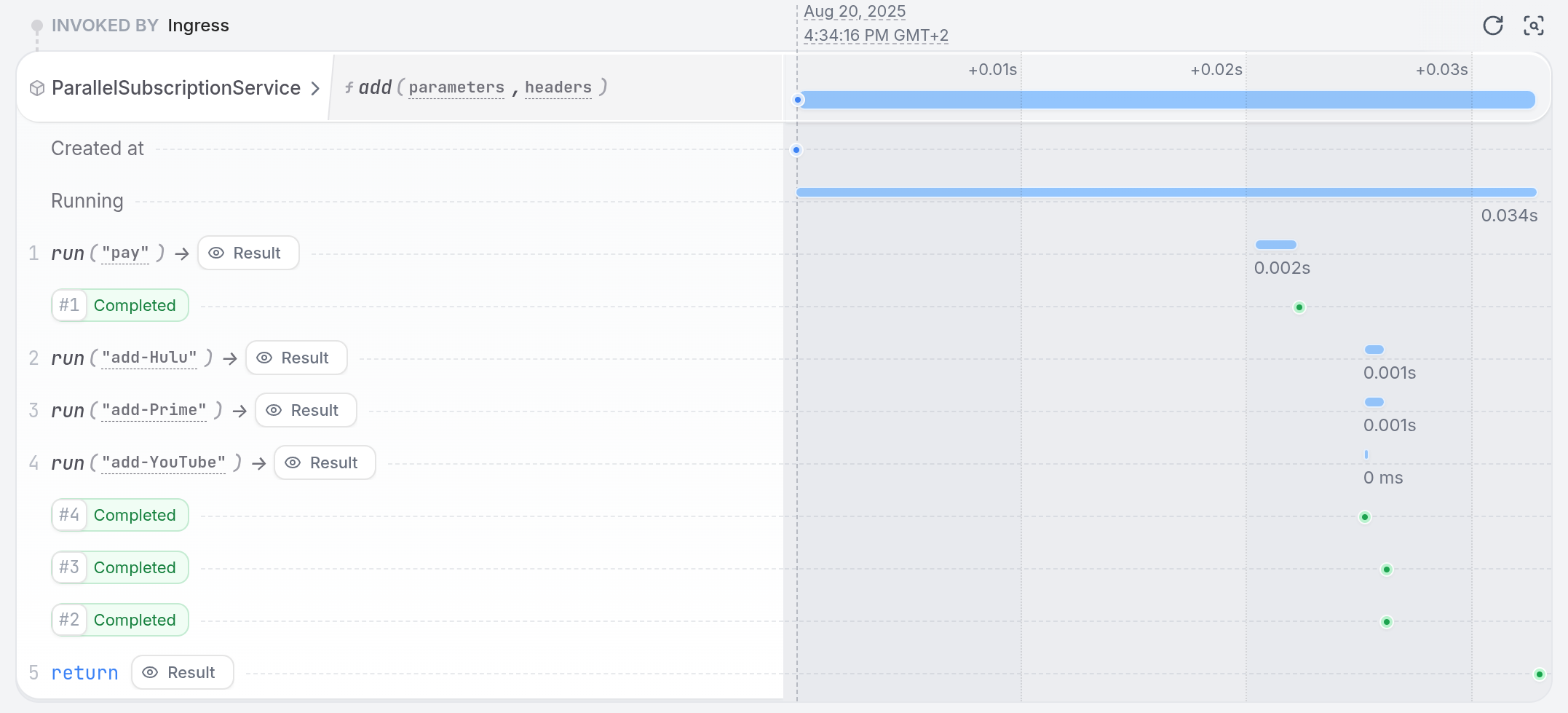 You can extend this to include the saga pattern and run all compensations in parallel as well.
Have a look at the Concurrent Tasks docs for your SDK to learn more ([TS](/develop/ts/concurrent-tasks) / [Java / Kotlin](/develop/java/concurrent-tasks) / [Python](/develop/python/concurrent-tasks) / [Go](/develop/go/concurrent-tasks)).
## Summary
Restate simplifies microservice orchestration with:
* **Durable Execution**: Automatic failure recovery without complex retry logic
* **Sagas**: Distributed transactions with resilient compensation
* **Service Communication**: Reliable RPC and messaging between services
* **Stateful Processing**: Consistent state management without external stores
* **Advanced Patterns**: Fault-tolerant timers, awakeables, and parallel execution
Build resilient distributed systems without the typical complexity.
You can extend this to include the saga pattern and run all compensations in parallel as well.
Have a look at the Concurrent Tasks docs for your SDK to learn more ([TS](/develop/ts/concurrent-tasks) / [Java / Kotlin](/develop/java/concurrent-tasks) / [Python](/develop/python/concurrent-tasks) / [Go](/develop/go/concurrent-tasks)).
## Summary
Restate simplifies microservice orchestration with:
* **Durable Execution**: Automatic failure recovery without complex retry logic
* **Sagas**: Distributed transactions with resilient compensation
* **Service Communication**: Reliable RPC and messaging between services
* **Stateful Processing**: Consistent state management without external stores
* **Advanced Patterns**: Fault-tolerant timers, awakeables, and parallel execution
Build resilient distributed systems without the typical complexity.